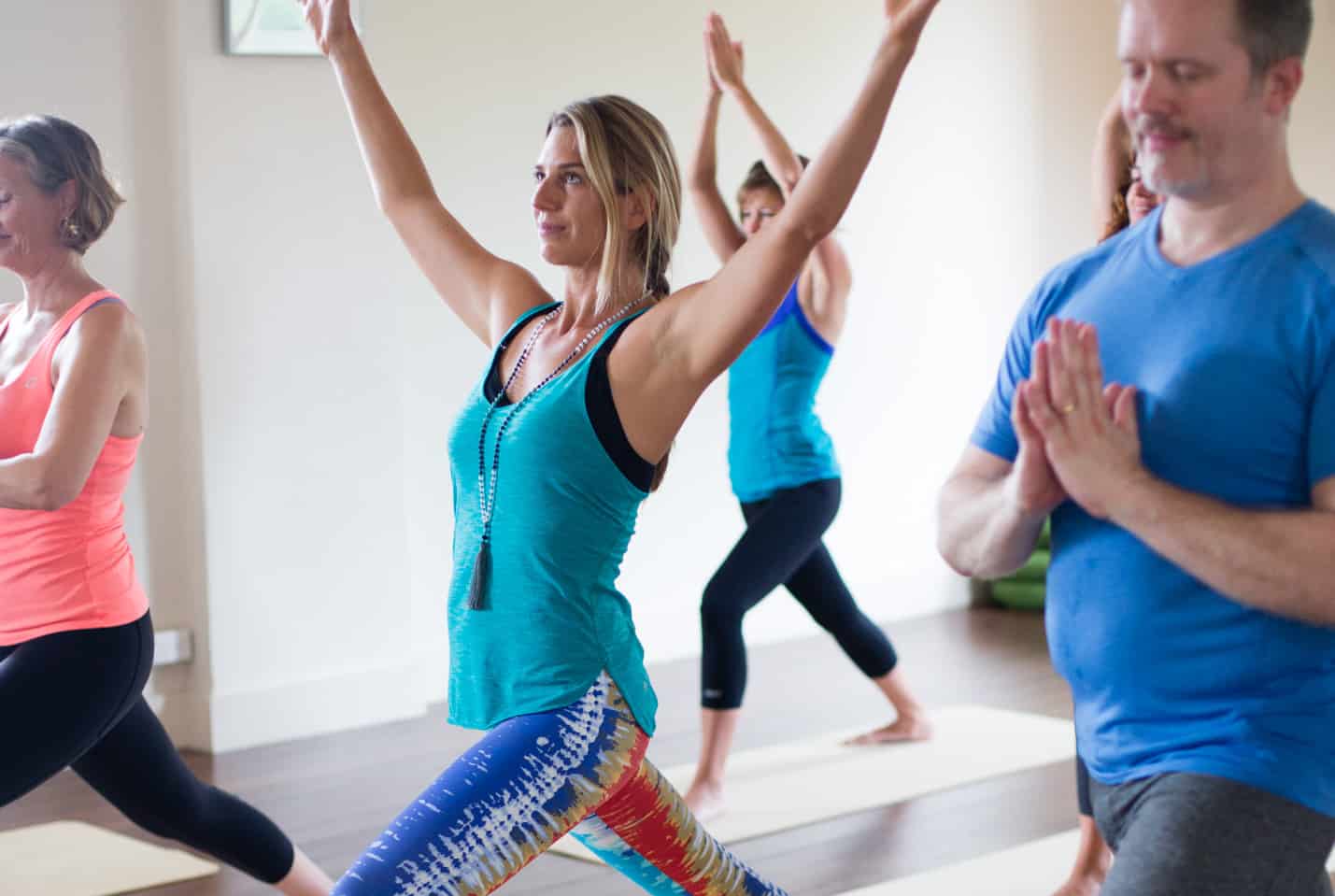
My Year of becoming a Yoga Teacher was the most transformative year of my life!
I’ve been a Yoga student for more than 20 years and always thought I would love to become a Yoga teacher, but for various reasons it didn’t happen. Then, I sold a business in 2018 because I needed a change, and I finally decided to do my Yoga Teacher training.
Why The Yoga Institute?
I did my research then went to the information session at The Yoga Institute. I was so impressed that I signed up straight away!
Although I didn’t want to wait until the following year to start the course and there were other Yoga teacher training (YTT) courses that I could start and finish before this one even began, I knew the The Yoga Institute was going to give me the best training to become confident enough to actually teach Yoga. Confidence and anxiety were my biggest challenges.
The most transformative parts of the course for me were the role playing and practicum. The Residential where I taught my first class to my cohort was a massive challenge and the highlight of the course. The many opportunities to observe, assist and actually teach classes before I graduated were invaluable. Additionally, the Communications training we had with Lucy promoted huge personal growth for me.
Other than the knowledge I learned throughout the course, these practical experiences pushed me through my comfort zone to build confidence and become a working Yoga teacher. The cherry on top was the fun and friendships.
After the Yoga Institute
There were many times when I doubted I would have the courage to teach, let alone find a teaching gig, but I was offered a position at the studio I was practicing at in February after I graduated, which I am grateful for every day.
This has given me the opportunity to practice my skills and fine tune them. Now I’m teaching 2 permanent classes a week and doing covers for 3 various studios. I’ve also learned how to teach Yoga online during the Covid Pandemic and continue to develop personally, and as a Yoga Teacher.
How can we support you?
Our Teacher Training Course isn’t just for aspiring teachers, but for anyone who wants to deepen their personal practice and gain a better understanding of yoga.
The Mentoring Component of Your Studies with The Yoga Institute
@markbondphotography
“Mentoring” is a modern word that describes an essential part of the tradition of yoga throughout history.
Yoga Australia recognises and encourages the importance of mentoring, both being a mentor and being mentored, at all levels of training and teaching in yoga. Here at The Yoga Institute, we have a team of experienced mentors who provide one-on-one mentoring for our trainees.
A dedicated mentor is one of the important (and cherished) features of our:
500-hour Yoga Teacher Training course
150-hour Yoga Studies course, and
650-hour Post-graduate Yoga Therapy Training
If you have never had a mentor relationship – particularly in the yogic sphere – you may be naturally curious how this works and why it’s so beneficial. So what is mentoring, and how does it work?
What is a mentor?
A yoga mentor is a senior Yoga Teacher, with extensive experience in their field.
Mentors live and breathe yoga, are committed to the teachings of the Yoga tradition and in addition to offering yoga in group or individual environments, they are very often also trainers themselves, helping to train aspiring yoga teachers and yoga therapists.
Our panel of mentors at The Yoga Institute are passionate about helping others and sharing their knowledge.
What can you get out of having a mentor?
– Additional support and guidance navigating your course and its workload
– The gift of a personalised yoga practice tailored to your own special requirements
– One-on-one assistance with assessments, course content and general yoga questions
– Support and advice through the practicum component of your course
– Insights from someone who remembers being where you are, and has the benefit of experience to share
– A dedicated source of encouragement and care
– Someone to help you see where your own habits and patterns (samskaras) may be self-limiting in your yoga journey
What are the qualities of a good mentor?
– Depth of experience
– A deep understanding of yoga, its history, context and applications
– Strong teaching, listening and communication skills
– Provides a caring, supportive and authentic environment in which to connect
What are the qualities of a good mentee?
– Curiosity to learn, question and seek answers to deepen their knowledge
– Open mind and open heart: allow yourself to being guided and to take on suggestions and feedback from an experienced mentor
– Commitment to steering the mentoring relationship and proactively booking and attending session with mentors
How does mentoring at the Yoga Institute work?
Dependent on the course you do, a number of sessions are automatically included as a feature (see below)
Shortly after your course commences, you will receive an email matching you to one of our mentors. Students will proactively reach out to their mentors and book their mentoring sessions in. The mentors are asked not chase students, to help students build discipline and responsibility.
You can meet where suits (Our premises at Cammeray is an option, as is via Zoom where necessary, though we encourage your first meeting to be face to face so your mentor can learn about your body to help you refine or build a tailored practice).
Typically, one of the first things a mentor will do is learn about you and help you review any existing home practice, or design a personalised practice for you, tailored for body and your individual needs at the time (physical, mental, emotional).
In addition to the specific mentoring session, mentors are available throughout your course via email and/or phone support to assist you along the way too
500-hour Yoga Teacher Training Diploma – includes 8 mentoring sessions
150-hour Yoga Studies course – includes 3 mentoring sessions
650-hour Yoga Therapy Training – includes 2 mentoring sessions per yoga therapy module (plus additional sessions for the Therapeutic and Professional Practice module)
Many of our students report mentoring as one of their favourite features of their training process, and some go on to privately enjoy a mentoring relationship with their mentor long afterwards. At the completion of your included mentoring sessions, you can chat to your mentor about a private arrangement ongoing if you wish.
If you have done (or are doing) training elsewhere and are interested in mentoring as a standalone service, please contact us for a chat.
Email or call us: teachertraining@yogainstitute.com.au | 0477 021 219
Yoga as a microcosm of life and a pathway to conscious living
Written by graduate of the 500-hour Yoga Teacher Training Diploma, Christine Chu
From my first exposure to yoga, I always knew I would be a yoga teacher. It was only a matter of ‘when’.
I was fortunate to discover yoga in my youth at 14. After viewing photos and videos on social media, I was instantly drawn to inversions and the playfulness of the practice, but what captivated me most was an unshakeable sense of liberation and an inclination to share it.
My self-practice developed with great ease and consistency. I practiced unguided daily, until yoga was offered as an extracurricular school activity to which I latched onto quickly. After my first official class, I remember rising up from savasana seated across from the teacher, with a great sense of homecoming and knowing, “This is the role I want”.
There were countless other instances where I had these experiences of knowing, but I blindly assumed yoga had the same effect on others and lightly brushed them off.
Ultimately, I came to realise that not all individuals appreciated yoga to the marked depth as I did. Almost each night after school and still to this day, my head hits the pillow with yoga philosophy and teaching on my mind.
Enter The Yoga Institute at 19! 500hrs and many months later, I am now blessed to be sharing this practice.
What Yoga Means To Me
I believe yoga is a microcosm of Life. What we experience in the world around us – impermanence, fear and obstacles – can be preempted and explored through yoga. The only requirement is an attunement to breath and a willingness to learn.
The beauty of the practice is that it grows as we grow- changes as we change. If we are willing to become quiet, turn inwards and remain consistent, our ability to navigate the world and our mind with ease and resilience grows stronger. Yoga is a physical discipline which, if given time, transforms to a mental discipline. It is a pathway to conscious living.
Creating a Sense of Homecoming for Others
Today I am completing my final year of physiotherapy studies and allowing it to inform my delivery of safe and functional yoga classes and workshops. Although the Western expression of yoga is heavily imbued with asana, I seek to further weave through the gifts of breathwork, meditation and philosophy to the Western understanding of yoga. I hope each practice moves students closer to their own homecoming (in whichever form that may be) and a remembrance of the empowered, creative beings we all are.
“Life is a GPS, you can’t go wrong, but you can prolong”
To any out there who are considering Teacher Training at The Yoga Institute (or any individual considering a new path or life change of any sort)- I look at you, and I see me, living another life.
We are all our greatest obstacles or our greatest launching pad. I firmly believe the resources, support and opportunities leading you to your goals are already here and simply waiting for you to get out of your own way.
Come with ease and a beginner’s mindset – You won’t go wrong and you will not be disappointed.
You can contact Christine via Email: christinechuyoga@gmail.com or Instagram: http://instagram.com/christinechuyoga
How can we support you?
Our study options aren’t just for aspiring teachers, but for anyone who wants to deepen their personal practice or simply gain a better understanding of the breadth and depth of the life-affirming practice of yoga.
We do not need a new calendar year to make fresh choices and implement change. We do not need a new week, or even a new day. Each breath is an opportunity to choose again, choose again, choose again.
As one year folds into the next, however, it can naturally be a time when our thoughts revisit the past, scanning for meaning and take-outs, and then to the future, possibly making plans and choosing things we would like to move towards.
Can we take learnings and blessings from the past instead of over-focussing on what we didn’t like? Can we harness the enthusiasm for change while avoiding the pitfalls common to New Years Resolutions? Here we take a look at some possible steps leading to new aspirations and their implementation, with the yogic outlook on change and acceptance.
Reflection
The transition from one year to the next can offer a precious opportunity to reflect. Reflection gives us the opportunity to pause amidst a hurried pace of life and potentially see things with greater clarity than through a haze of in-the-moment, reactive emotions. It can be a valuable way to untangle thoughts and derive learnings from experiences.
Reflection for many people means simply looking at our externalities: what went well, what was difficult, what happened to us.
Our brains are pigeon-holing machines, they love to categorise and label things, this is good, that is bad. We may enjoy a chuckle and the feeling of solidarity that comes from farewelling a year collectively deemed to be ‘bad’ through shared jokes and memes.
But let’s pause: Was the year really all bad? What if we resist putting a label on our years? And do we really want to wish time away?
Because of our brain’s tendency to give greater focus to circumstances that gave rise to difficult emotions rather than pleasant ones (a phenomenon known as negativity bias), a practice of reflection based entirely on external circumstances can end up being an unsatisfying replay of everything we found challenging without the counterbalance of all the things we can feel grateful for.
TIP 1:If revisiting the circumstances of the past year, be mindful to include a list of the many, many things that went your way and that you feel thankful for.
When we’re feeling irritable this can be more challenging; pause for conscious breath to feel the lifeforce moving inside you. We can thank our cells and organs for their hard work every day, thank our microbiome for extracting nutrients and bolstering our immunity, we can feel gratitude for the privileges of modern living including clean, drinkable water on tap. Once you get started, gratitude tends to snowball under its own momentum!
TIP 2: If the past year included genuine struggle or misfortune, sadness may be an appropriate and healthy response. You can allow yourself to feel sadness without setting up camp there. Sadness is a tunnel, we all have to go through it at some stage to get to the other side, but take heart that sadness is a tunnel, it need not be a cave. Be gentle and patient without yourself.
TIP 3: Reflect on what lessons the past year might have given you. What learnings would you like to carry forward? Maybe the year affirmed for you just how strong you really are, what people you want to surround yourself with, or to take some of the joys of slower living that arose out of lockdowns, into regular life. (See ‘Lessons from Lockdowns’).
Sidenote 1 –Lessons from Lockdowns
We can be hopeful of no further lockdowns while still appreciating the lessons lockdowns of previous years have brought to us:
1. The importance of looking after our physical and mental health 2. The power of community and connection 3. The soothing and healing power of a connection to nature 4. The joys of a slower pace of living and time for hobbies 5. Things like job titles, brands, and Hollywood & Instagram celebrities all seemed less important, while scientists, academics and healthcare workers were elevated and bestowed society’s attention and admiration
Now is our chance to hold onto some of the wisdom that revealed itself to humanity during our more challenging days, and carry it forward.
Self-enquiry
For yogis, the word reflection more often actually means self-reflection or self-enquiry, rather than reflecting on external circumstances. We can acknowledge the externalities (and especially the things we are grateful for) and then turn our attention to our inner selves.
Self-enquiry is also referred to as svadhyaya, the fourth niyama (personal observance) in Patanjali’s Yoga Sutras, related to self-study and introspection.
Classically associated with mantra or scripture recitation, a modern take on svadhyaya is any activity that allows us to quietly observe ourselves: our thoughts, emotions, actions, motivations.
Self-enquiry can both play an important role in our spiritual journey as it expands our self-awareness: Self-analysis helps us examine not only our actions and reactions, but also the deeper layers steering our actions and reactions, namely our underlying beliefs, patterns and attitudes. Why did we react that way? Why we were so quick to judge that person? Taking time to be curious and note these can help us identify new ways of being we might wish to work towards.
Self-enquiry requires mindful vigilance of our mind’s journey, lest our self-reflection mutate into a looping reel of all the things we don’t like about ourselves, with all of our perceived flaws and mistakes playing over and over. Yogic self-reflection is about noticing with curiosity and compassion for ourselves, not admonishing or shaming ourselves for being human. It’s helpful to also reflect on instances where you responded in a way the you from years ago may not have. Acknowledge the work you have already done becoming the person you want to be.
A simple example of self-enquiry may arise when we observe our patterns in asana practice as we enter discomfort. A breakthrough for yoga practitioners is when they truly discern the difference between discomfort and pain. We never move into pain on our mat, but we can learn not to immediately run from discomfort. If we are honest about our body’s messages and learning to distinguish unpleasantness from pain, we can learn to sit with discomfort and thereby see our incredible capacity for strength and tolerance. Lessons on the mat then seep into our daily lives.
TIP 1: When observing tendencies that you would like to work on, keep your inner critic in check by recalling that we all have traits that do not serve us, we all have a darker side. In many cases, we can even be blind to them, so congratulate yourself on identifying and acknowledging a quality you would like to work on.
TIP 2: Similar to above, we all make mistakes. Mistakes can be amongst our greatest teachers. Acknowledging them is akin to accepting constructive feedback as a gift. A mistake is just a lesson in another form. Practice forgiving yourself.
Sidenote 2 – Do your New Year resolutions include changing the way you look?
For many people, the new year is a time to plan to change something about their appearance. New Years Resolutions are often about our outer self and the way we look. If you search poll statistics on what ratio of people state ‘weight loss’ as their number one resolution, you will find around half of all New Years Resolutions are related to losing weight.
It is indeed important to look after our physical health, eating well and staying active are important pillars in physical health, but weight and shape do not necessarily correlate to good health. If deep down, your goal each year is motivated by a desire to change your outward appearance, we invite you to build a different relationship with your body.
Believing we can deprive or overwork our bodies to yield to our wishes indicates a disconnect between a person and their body. Your body is not something separate to your heart and mind that can be punished into submission.
Continued yoga practice helps us re-connect with our body: to feel love and gratitude for the myriad of things it does for us each and every day, to marvel at its ability to move, to assimilate food, to heal, to dance, to see, to hear, to touch, to smell, to send us messages when we need to slow down and rest, to carry things, and to carry us through this life. With regular yoga practice, we can accept genetics and physical limitations and importantly, shape.
We come onto our yoga mats to honour our bodies, not to punish them. Our bodies deserve our reverence, not our scorn. Our shape may never change but our health can. Critically, so too can our mindset around our bodies and the way we cultivate self-love and self-esteem.
A true and honest yoga practice can set us free from self-worth linked to appearance and other temporary conditions such as youth. Through yoga we learn to value that which is unchanging within us.
May you come to see that you are already precious and perfect, just as you are.
Continue reading below to learn more about the difference between resolutions and intentions, and swapping goals based on rigid end-results or achievements, for loving practices based around lifestyle change and mindset shifts.
Z s
Resolutions and Intentions
A new year can be an appealing time to think about letting go of certain things and practising new things, especially if you have just spent some of the holiday period in self-reflection. The natural extension may be to choose things to work on. We can do so in a conscious and sustainable way.
Many people liken their efforts to change as ‘self-improvement’. It’s an easily understood and widely used phrase and while its usage is not really problematic, it’s not quite accurate either. The yogic approach to change is about developing practices that move us closer to our true nature. It’s arguably not really about self-improvement as your divine, true nature needs no improvement. It’s more about regular practices that serve us to shed what is an obstacle to our true selves.
Resolutions, intentions, proclamations?
If we start each new year with the vague but dogged proclamation, “This is going to be my year!”, our mind is already clinging to the notion that everything will go our way. We are already exhibiting resistance to the natural flow of life. It’s the flipside to looking back at a year and dismissing it as just ‘bad’.
Change can be a very worthwhile pursuit, but not always easy. Start with small, specific and manageable actions that you can add on to later, and try to resist the urge to predict the outcome, instead focussing on the lifestyle change.
Herein lies the difference between resolution and intention:one is very results-oriented, the other more about changing our mindset and developing beneficial practices. One doesn’t leave much space for missing a day or making a mistake, while the other is patient and forgiving, and moulds to your real-life.
The word ‘resolution’ may inadvertently capture a somewhat rigid, all-or-nothing sentiment, meaning the first time we even slightly deviate from a fixed goal, some unkind self-talk kicks in and we may feel inclined to give up.
Intentions (often referred to in yoga as sankalpa) are not about your daily/weekly /monthly outcomes or achievements, they are about how you are being and living. Intentions help guide our actions.
Resolution: the focus is on the end-results and is dependent upon willpower
Intention: the focus is on your attitude and the way you live, and is self-energising
If resolutions work well for you, fantastic! But they don’t work well for everyone, so intentions can be a good alternative.
How does sankalpa work?
A sankalpa is a statement of a deeply-held value and phrased as present-tense affirmations, rather than future-tense desires.
Let’s say your goal is to be more patient with yourself and others. You may bring this awareness to your senses at the start of each yoga practice with a simple statement such as, “My true nature is patience and kindness”, and then during your practice as you are noticing how postures feel in your body and noticing your breath, observe if this trait pops up. You may notice yourself feeling frustrated or impatient with yourself (or with your teacher). Try to catch this emotion ‘in the act’ without judging yourself for it, “Ahhh, I’m being visited by impatience again!” . In this way, we are practising being aware of how we’re being.
You may like to then revisit your sankalpa as an affirmation after some pranayama or meditation when your nervous system is relaxed and brain waves are more receptive to suggestion. We can additionally summon gratitude for the way of being we are moving towards. It may seem counterintuitive to feel gratitude for something we don’t yet have, yet the more we can practice feeling gratitude for something as if it has already manifested, the more we pull it towards us.
Perhaps your goal is around health, you may choose a sankalpa such as, “My body is strong and healthy”, or “My body’s natural state is health and wellbeing”, or “I am already whole and healed”.
Practice without attachment to result
Through sankalpa, we let go of the striving and pushing of a conventional resolution, but this does not mean we cannot utilise effort. Desire alone is not enough to create change.
There exists a degree of persistent effort (known as abhyasa). For example, if we lack the discipline to bring awareness to our sankalpa on a regular basis, the desire to be more patient will likely remain just a wish. We’re not talking about a forcing, pushing kind of effort; it may be as simple as diligently creating the space in your day for a 5-minute conscious breathing practice, creating the opportunity for yourself to walk barefoot on the grass, or to give yourself a foot massage in the evening. These is a degree of effort to help these practices become regular and consistent in your life, but they manifest very differently to the willpower-propelled efforts of results-oriented resolutions.
Similarly, we can draw in help and guidance to learn and grow, but we cannot outsource the work. The effort and responsibility to make a shift in our life will always sit with each one of us.
Each new year brings a raft of commercial enterprise ready to convince you of a personal growth or self-improvement quick-fix. Choose your source of learnings and guidance with deliberate discernment and be willing to create the space in your life to do the work: slow, steady and far from the glow of social media and other external sources of validation. Your character is what you do when nobody is looking.
Gentle practice allows us to balance effort (abhyasa) without attaching to an outcome (vairagya).
If your constitution is typically one of action and striving, it may take more practice to ease back on striving and a focus on results. If your constitution is typically easygoing, it may take more practice to bring about consistency with the effort part of your implementation. We are all different, so just allow your path to be your path as you journey.
“No matter what situation we find ourselves in, we can always set our compass to the highest intentions in the present moment” – Jack Kornfield
Choosing your sankalpa
Below are some ideas of things you may like to let go of, or embrace. Your reflection and self-enquiry will help you think of others too. If one of them leaps out at you, it may help you consider formulating a sankalpa to take forward.
Things you may want to let go of:
Perfectionism
Comparison to others
Toxic or unsupportive people
Making yourself smaller for other people’s comfort
Old resentments
Impatience
Gossip
Things you may want to embrace:
Communicating your needs
Listening to your body
Listening to your inner voice
Nourishing your inner child with more play and laughter
Learning more about the philosophy side of yoga
Prioritising self-care routines
Opening your heart to new experiences and people
Patience and kindness
It’s never too early or too late
To change your life, change your choices. Recall that you can start any new way of thinking or living right now, with each new breath.
Now pause and take a deep and slow breath…… If you don’t like the thought in your head or would like a different state of being, every moment has the freedom to start afresh and choose again. One of the gifts of being human is that we have evolved to be conscious of our own existence, and aware of our own awareness. We have the privilege of being aware of our own existence, to select the thoughts that are allowed to be in our head, and to choose how we are being. What a magnificent gift – Happy New Year!
From Gym Junkie to Aerobics Instructor to Yoga Teacher
Written by graduate of the 500-hour Yoga Teacher Training Diploma, Marion Just
It was in my early 20s that I embarked on a path to get healthy and fit, learning about good nutrition, eating less and exercising in the gym…. ALOT! I was a serial gym junkie.. even becoming an aerobics instructor for a few years.
Then one day (still in my twenties) while working in the city I checked out the Adyar Bookshop in York Street where I discovered an entire wall of yoga books. Intrigued I decided to try this yoga although there were very few studios in which to practice. I dabbled in a few classes, but it didn’t excite me enough, so I stuck with sweating out in the gym until my late 30s.
It was at that time I discovered the first Australian Bikram studio had opened up near my home on the northern beaches. I knew about this Bikram yoga as it was the only book I purchased at the Adyar Bookshop. So I gave up the gym for another sweat filled room in Bikram’s studio -aka- the “torture chamber” for almost 10 years. Then another type of strong and strenuous yoga landed on our shores – Vinyasa Yoga. Woohoo!
When I realised yoga was more than just physical exercises
After some 25 years of sweating it out and contorting the body in hot yoga rooms I felt there must be more to the practice than just asanas.
During those years, Sanskrit words were sporadically used to describe asanas. Words such as the ujjayi breath, the bandhas and drishti were mentioned. What did it all mean anyway? Who was Patanjali? What were the Yoga Sutras and the 8 Limbs? Did Patanjali have 8 limbs? What had I been practising all those years?
What brought me to teacher training?
I can’t really pinpoint what compelled me to seek out teacher training. There were many opportunities to sign up for teacher training at the heated yoga or the vinyasa studio, but something intrinsically kept holding me back!
Then one day, I was ready to finally put all the pieces of the puzzle in place – to learn more about yoga’s history and philosophy.
Oh My Goodness – I signed up!
After scanning the internet I found The Yoga Institute, phoned them, attended the information session and just like that – I signed up! I was very excited. And then the excitement turned to fear.
What followed were feelings of anxiety, hesitation, regret, uncertainty that I had embarked on an intensive course of which I knew very little and which required a huge commitment.
My fear rapidly subsided when I had my first session with my fabulous mentor who re-assured me and helped me focus on an important component of yoga – breath control and chanting with a little bit of asana to keep the mind focussed! Wait…what?
Initially, the practice of chanting, pranayama and gentle asanas to help me release thoughts of attachments while quietening the mind seemed very strange and I didn’t take to it immediately. I quickly realised and felt the benefits of slowing down and practising breath awareness. My mentor knew best.
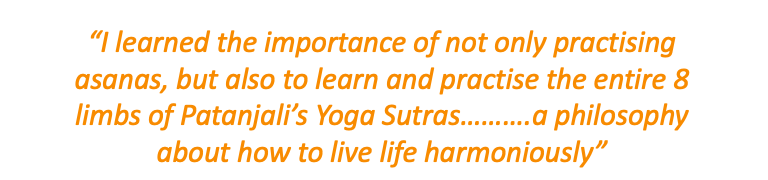
I learned the importance of not only practising asanas, but also to learn and practise the entire 8 limbs of Patanjali’s Yoga Sutras. No, not Patanjali’s limbs – the 8 aspects of the Yoga Sutras – a philosophy about how to live life harmoniously.
Post Teacher Training
Since completing my training, I was fortunate to have the opportunity to go back to where it all started for me and to teach a yoga class on Mondays for a short time in the Cammeray Yoga studio, back on the premises of The Yoga Institute!
I currently have a home studio set up where I teach my corporate clients online via Zoom, as well as group classes, and one to one personal yoga training.
How does yoga fit in my life now and how has it changed me?
Many stages of my life have been filled with sometimes overwhelming challenges. If I had found yoga in the early stages of my life, I believe I would have learned how to better handle these challenges – I’m certain I would have been a calmer, less stressed person for it.
Any obstacles and annoyances that I encounter now are a lot more manageable when I stop and take time out to practise pranayama and meditation.
To anyone considering doing Teacher Training at The Yoga Institute
I am so pleased that I chose The Yoga Institute for my teacher training. Each of the teachers are world class, incredibly supportive and thoroughly knowledgeable.
The co-founders, Dr Michael de Manincor and Lisa Grauaug studied for many years with the son of the father of modern yoga (Sri Krishnamacharya) TKV Desikachar. My assigned mentor studied meditation with A G Mohan who was a personal student of Sri Krishnamacharya for 18 years.
The best part of the journey for me has been learning to sit quietly, drawing inwards to meditate, learning to become un-attached to things that aren’t so important, to gain contentment within myself and to connect to my inner light of consciousness. Hopefully one day I will attain the 8th Limb of Yoga, SAMADHI – to experience bliss and enlightenment! YES!
Our Teacher Training Course isn’t just for aspiring teachers, but for anyone who wants to deepen their personal practice and gain a better understanding of yoga.
Making that big career move from the corporate world to Yoga teaching
Silvia’s Yoga Journey
I started 11 years ago at a local studio in a group class setting. At the time, I was seeking ways to improve my mental and emotional health – this was the beginning of my Yoga story.
Ever since, I have been on and off with my practice which mainly consisted of group classes in a Yoga studio or gym. I always was drawn back to Yoga and decided in 2018 that I would partake in studying Yoga.
After thorough research on where to do my Yoga teacher training (YTT), I narrowed down two potential places.
Why The Yoga Institute?
I went to The Yoga Institute information session at Cammeray and immediately knew I was at the right place. I fondly remember my chat with Kirstie Christensen who spent her time in the kitchen guiding me through the course – she ended up fittingly being my mentor during my studies!
Studying Yoga Abroad
Since completing my 500hr YTT in 2019, I have also fortunately travelled to do further studies abroad in India – Developing a Personal Practice at Yoga Vahini with Saraswathi and Yoga for Mental Health at Baulkham Hills Yoga Studio with Michele Sierra.
My trip to India was beyond my expectations, and if it were not for the lovely Lisa Grauaug who organised a group connected through The Yoga Institute, I would have been unaware of this opportunity.
What Silvia loves about Yoga
First thing that comes to mind are the practices or poses. Those who know me are aware I love Warrior poses and sequences, particularly “Warrior 3” (Virabhadrasana III).
I also love strong poses such as “Chaturanga” and “Upward facing dog” (Urhva Mukha Shvanasana) in a sequence.
I enjoy pranayama techniques that are calming and focusing in nature. Initially, I struggled with designing class plans (mainly because of my drawing skills!) But now I genuinely enjoy creating class plans bearing in mind intelligent sequencing, as Michael would say, and tailoring to student’s needs by researching online and through books.
A career shift to teaching Yoga
I have had a colourful working life, where I’ve dabbled in various careers ranging from childcare work to 8 years as a Senior Consultant in Personal Injury Insurance.
Towards the end of my YTT course, I was working in my insurance role and I knew I “hit the wall” mentally and physically as I was no longer able to continue working. After a career break, completing my YTT studies, my new “career” aim was to be a full-time Yoga teacher – which I fortunately currently do.
Initially, I thought my path would be Yoga for children, and I was interested in further studies to teach Yoga at schools. However, my path detoured down to Yoga for mental health, and I am truly happy.
Silvia’s experience as a Yoga teacher
As a Yoga teacher, I have taught at various gyms, outdoor yoga as a part of a bootcamp, teen yoga at a girl’s Catholic high school, teachers at a Muslim high school, physiotherapy and remedial massage clinic, and classes at a community hall run via the Liverpool council. I still teach 3 classes at a gym and one outdoor class on Sunday mornings.
Now, I predominantly work at a Private Mental Health Hospital where I teach Yoga to inpatients and outpatients.
Yoga was included as a part of the inpatient and outpatients’ treatment program. During the COVID lockdown, they would only have group therapy sessions and art therapy, while the gym and walking group were temporarily stopped.
The patients really embraced the classes – it is an amazing feeling to know patient’s and management at the Hospital recognised the benefits of Yoga to the patients’ health.
Whilst it can be challenging at times, it is completely rewarding seeing patients who, for instance, were jittery and anxious at the beginning of class and by the end were calm and centred. I had a few patient’s say that they no longer needed to take Valium and no longer experienced side effects of certain medications they were on. Yoga had allowed them to feel at ease.
How did Silvia obtain this teaching job?
I was in a consult with my treating Psychiatrist who mentioned the Hospital was looking for a Yoga teacher. During the consult, he called the Allied Health Manager informing her that he had a teacher and an hour later I was having an interview with the Manager and Chief of Staff!
This occurred pre-COVID and I began teaching 3 classes a week, post-COVID my classes jumped to 14 a week! Now, I teach 11 classes at the Hospital.
Overall, I teach 15 classes a week, for me personally it is manageable and can earn a solid living.
Advice for aspiring Yoga teachers
It has taken time, a good self-care regime, and support from loved ones along with a Yoga mentor and my psychologist to adjust.
My advice regarding opportunities for Yoga teachers is to think outside the box. Approach not only gyms and studios, but schools (for students and teachers), physiotherapy or other allied health clinics, hospitals, sport clubs (e.g. soccer teams) and bootcamps.
“Yoga is a gift“
I have been lucky to be guided by few mentors, including Lisa and Kirstie from the Yoga Institute. Another is Laurin Vassella a YTT graduate as well, and she mentioned a statement that really resonated with me – “Yoga is a gift”.
Each time I teach and particularly when I receive feedback from a student on how my class impacted them, I think of this statement and how Yoga is truly a wonderful gift that I enjoy sharing.
Our Teacher Training Course isn’t just for aspiring teachers, but for anyone who wants to deepen their personal practice and gain a better understanding of yoga.
I had been working in the Events industry for over 12 years and had always excelled in high pressure, high stress environments. Or so I thought.
Over time, it was evident that the stress I had repressed for so long, manifested physically, in my body through debilitating neck pain, regular migraines and always getting sick. I was also into HIIT (high intensity intermittent training) quite regularly because I had been obsessed with wanting my body to be ‘just perfect’. In hindsight, what I thought was a stress reliever, actually became a stress enhancer.
The Switch to Yoga
I turned to yoga initially for the physical benefits – to help ‘stretch’ out my tense neck, shoulders and back. To help me feel ‘physically OK’. What I didn’t realise was that it actually had a profound effect on my capability to calm myself, to relax my mind, which is something I had always struggled with.
Fast forward three years, I was feeling more self aware and in less pain! (I even changed roles so I was no longer running events), I was determined to discover more.
Stacy’s Year (2020)
Ah 2020! A year for the history books that’s for sure.
My partner and I found ourselves on ‘stand down’ indefinitely as the parent company we worked for was in the travel business – something that overnight disappeared. What had initially been my year to balance a full time job and full time study to become a yoga teacher, it became simply ‘full time study to become a yoga teacher’.
I would love to say I threw myself completely into the course, but as many of us have experienced during this pandemic, it has been a rather anxious and unknown time, so there were many days when it was just simply all too much. However, little by little, I began to make yoga a regular part of my month, then my week, then my day.
The Shift
And something shifted. As someone who was identified as an atheist, I had found a ‘God’. Not the usual God related to a religion, but I had developed a deep appreciation of Mother Nature – my God. My ‘being’ that I could completely and blindly place all faith in to look after me. My sense of gratitude – for the strength and health of my body, the warmth of the sun on my skin, the beauty of the oceans and bushland that surrounds my home town – has never been stronger.
And it’s made me a better version of myself, helping me to ‘let go’ of perfection, and greatly influencing my relationship with others, the environment, and most importantly, myself.
Stacy’s Future
I am looking forward to graduating at the end of the year and continuing my studies further in Yoga Therapy. What started out as a ‘life enhancement’ (which it certainly was!), I have now decided that yoga is too good not to share.
I am hard of hearing and have found that not all yoga classes are suited to those who can’t hear too well. I hope to teach yoga to those who need additional support, in aged care and mental health programs, along with any other areas that are in need of speciality yoga.
I believe that yoga is to be shared amongst all of us, so that eventually we end up with a calm, already perfect, self aware community in love with Mother Nature.
Inspired by Stacy’s story?
Our Teacher Training Course isn’t just for aspiring teachers, but for anyone who wants to deepen their personal practice and gain a better understanding of yoga.
As yoga practitioners, many of us have felt yoga’s benefits firsthand when it comes to our mental wellbeing, even if only to soothe our mood on a stressful day or feel a little brighter on an uphill day. Yoga is ultimately about developing our capacity to change the way our minds work, where our typically easily-distracted mind is neither in a state of agitation (kșipta) or a state of depression (mūdah), so it is little wonder that yoga practitioners can experience glimpses of yoga’s potential for mental wellbeing.
You may need no convincing when it comes to yoga’s therapeutic capacity, but you may be curious about how it actually works.
Mental wellbeing – where yoga meets science
While the modern western paradigm may define mental health as a simple absence of mental illness, the yogic view of mental health is more expansive, including the mind at its optimal functioning, clear, calm, focussed and self-aware.
In yoga, mental health is not simply the absence of a condition. Nor is it the absence of a particular emotion such as sadness, as feelings like sadness can be an appropriate response to some circumstances. We can therefore, stay away from labels such as ‘positive emotion’; and ‘negative emotion’. The emotion itself is not the problem; problems arise when we don’t know what to do with a certain emotion. That is, it is how well we deal with the circumstances and our emotions that describes our mental wellbeing.
Resilience then, does not mean we wont be visited by tough emotions in life, rather it refers to our ability to get back to a state of balance and steadiness (equanimity).
It is satisfying to see an ever-bourgeoning pool of scientific studies in reputed peer-reviewed scientific journals, providing mounting evidence for yoga’s evidence-based efficacy to assist treatment of multiple type of mental health issues, including serious and chronic issues.
How does yoga help mental wellbeing?
We often hear about certain poses for depression or breathwork for anxiety and such, but the reality is there is no magic pose or breath practice that suits any one condition. Contrary to the often watered-down (or misrepresented) techniques and wisdom seen on social media that present yogic techniques as quick-fix ‘hacks’, yoga is not about quick-fixes or hacks. Yes, we can sometimes enjoy certain relief from certain moods or thoughts in a more immediate sense, but sustainable change involves a little more patience. When we plant a seed, we don’t expect to see a towering oak tree the next day!
An integrated yoga practice is a holistic system, capable of engaging with thoughts, feelings and actions at once, that does not see to treat the ‘illness’, it simply serves the person as a whole.
“As a yoga therapist, focus on increasing people’s quality of life, not on curing diseases” – T.K.V Desikachar
Yoga works by identifying an appropriate practice for one’s own circumstances (a yoga teacher or yoga therapist can assist you with this) and then showing up for yourself again and again. As your needs and circumstances evolve, so too may your practice (you’re unlikely to be suited to the practice that worked well for you at age 25, at age 65!), but the key is consistency.
We live in a fast world with a decreasing attention span. Quietly doing your practice each day – particularly alone – does involve some effort and discipline, but we approach it lovingly not punishingly, and as time passes we develop patience and a sense of friendliness for our bodies.
Change occurs not only in the physical body, but at less tangible levels too such as emotions and thoughts, all working in concert.
No ‘hacks’ or quick-fixes, just sustainable change. This is yoga.
The connected nature of an integrated yogic practice
It may be tempting to try and separate yoga’s ingredient components to their effects and benefits – “asana provides this”, “meditation provides that”, and so on – and while we can do this to an extent, it’s useful to remember that the 8 limbs of yoga are not a disparate collection of steps, done one after the other in isolation, but elements that will overlap and bleed into one another. Separating the concepts reduces their power.
For example, if we liken the physical postures of yoga (asana) to simple exercise, we could well say that this portion of the practice provides for release of tension in muscles, a release of feelgood endorphin hormones, and even improved satisfaction with body image. All true….
…But when we practice asana, we can be drawing from the banquet of yogic elements: we link our movements with conscious breath, we use mindfulness and concentration to notice sensations in our body. We may be incorporating chanting and mantra. We practise moderation each time we make a conscious choice not to over-extend, and non-judgement and kindness for ourselves when we notice a self-critical thought arise and let it subside…..and so on.
Similarly, when we meditate, our chosen pose is a form of asana, and we may combine our meditation with conscious breathing or mudras. And once again we are using awareness to practice noticing the lapses in our concentration.
In a yogic lifestyle, the eight limbs of yoga are all working together to regulate the turbulence of the mind. It’s too simplistic and inaccurate to separate them out into distinct components, this limb of yoga to remedy this, another limb to remedy that. Each limb works together and often overlaps.
Yoga, therefore, can provide that nice instantaneous sense of wellbeing we all enjoy immediately after a class, but when we allow the component ingredients of yoga to work together over a regular practice, a powerful and more lasting effect is emerging.
We are not just benefitting from a short-term ‘relief’ from distress, but are actually changing our brain and way of being.
The science of our yoga practice
It was once believed in western thought that the brain was not capable of change after childhood, that it became fixed. Today we know the opposite is true. Neuroplasticity refers to the brain’s ability to change its structure, chemistry and function. The ancient yogis knew this.
A quick biology lesson on neuroplasticity
Cells are the biological building blocks of life. There are hundreds of different types of cells in the human body. Our brain and spinal cord comprise that marvellous control centre known as the nervous system, and the chief nerve types in the nervous system are neurons and glia. Neurons are information messengers, all of our actions, thoughts and emotions are signalled by neurons.
Every time you think, feel or do something, neural pathways in your brain light up as cells communicate with one another along network tracks, like train tracks or a road. You may hear the term ‘synaptic response’: The synapse is tiny space between cells where chemical or electrical messages flow from one cell to the next.
If our way of thinking, feeling or doing is well-established, we call it a habit or a pattern (or in yoga, we refer to ‘samskaras’). The brain loves to rely on habits and patterns, because they consume less glucose (energy) than making conscious choices, thereby conserving glucose in case you need to fight or flee from a threat!
The neural pathway is carved deeper and deeper each time it is travelled, making it easier and easier for our brain to travel that road… regardless of whether that habit serves us well or not.
But when we choose a different emotion, learn something new (including observing our yoga practice with a curious beginner’s mind) or think about something from a different perspective, the communications signals between cells starts to travel in a new road.
The more we practice this new way of thinking, feeling or doing, this new road is carved deeper and becomes more second nature and therefore easier and easier to maintain. The old roadway weakens with reduced use. Habits are therefore, not necessairly a bad thing, we can make them work for us.
What else is going on with sustained yoga practice?
The integrated yoga practice is capable of:
Naturally producing chemicals similar to what pharmaceutical companies aim to reproduce in a laboratory
This includes:
serotonin – stabilising mood and helping digestive processes and sleep (acting as a precursor to the sleep hormone melatonin).
dopamine – also playing a role in the above-described functions, as well as memory, learning and motor function.
GABA (Gamma aminobutryic acid) – reduces activity in the nervous system, producing a calming effect.
Making our brain waves (your brain’s electrical activity) more coherent The typical neuron looks like a little hairy tadpole, its furry-looking tentacles (dendrites) receiving information from other cells, and its tail (axon) transmitting signals outwardly. They transmit at the same strength and speed, but what can vary is the frequency of these electrical pulses. Neurons tend to like to sychronise their electrical firing in rhythmic bursts, like waves.
Brain waves are measured in Hertz, the cycles per second. You may have heard of beta, alpha or delta waves. Delta waves (1-4Hz) are common in dreamless sleep. A dominance of delta waves in an awake state can make concentration difficult. Beta (12-38Hz) is our normal waking state when our attention is directed towards an activity or task, but we don’t want our brains still processing information at a high level when we’re trying to sleep. Alpha waves (8-12Hz) is like our reflective state, awake but at rest. Theta waves (4-8Hz) are associated with daydreaming and sleep.
Meditation in particular, enables us to move to lower frequency, giving rise to the opportunity to respond rather than react. Some seasoned meditators display gamma waves, even when not meditating.
Increasing grey matter in the Hippocampus and frontal sections of our brain Grey matter is associated with learning, memory and thought processes, while our frontal lobe is responsible for decision-making and self-control.
Reducing grey matter reduction in the amygdala (fear centre) The amygdala is what drives our fight or flight response. When in operation, the healing and rejuvenation of the rest and digest response cannot function. Yoga placates the amygdala’s activity.
In this way, we observe how yoga practice can result in improved concentration and self-awareness, better impulse control and mood regulation, the ability to respond to circumstances rather than reacting, increasing patience and tolerance (reducing the power of external stressors), and the release of long-held held-emotions and patterns.
Yoga is increasingly coupled with allied health and found in mainstream medical environments as evidence of its effect on mental wellbeing becomes irrefutable.
The scale of global mental health problems
There are many different types of mental health issues, such as depression, dementia, schizophrenia, post-traumatic stress disorder (PTSD), obsessive compulsive disorder (OCD), eating or substance abuse disorders, and anxiety (which includes things like phobias, social and panic disorders and generalised anxiety disorders).
Across the spectrum of problems, it is estimated that over a billion people globally are impacted by a mental health issue. In Australia, it is estimated that half of Australian adults will be impacted by a mental health issue at some point.
Advocates for government investment into mental health point to the estimated US$2.5 trillion lost to the global economy each year by poor mental health. Despite the magnitude of the statistics and the strong economic case for investment in mental health, a report collated by the World health Organization in 2017 concluded that member nations were spending less than 2% of their annual budgets on mental health.
Globally, many people with mental health issues are unable to access mainstream treatments for mental health issues, or are unsuited to use them because of possible adverse side effects.
Yoga is held to be a safe and relatively accessible treatment, with efforts towards expanding yoga’s accessibility (such as The Yoga Foundation) helping to stretch the reach even further.
The pandemic’s effects on global mental health
The full effects of the pandemic’s impact on our mental wellbeing is likely yet to be fully-felt, let alone fully-measured. Yet logic tells us that the distress caused by loneliness, isolation, loss of income, fear of job-loss, lack of human touch, fear of infection, and bereavement will all take a heavy toll on human health. Already psychologists and therapists are reporting a rise in the occurrence of anxiety and depression.
The pandemic will likely elevate mental health on the list of global health priorities if we are to avoid a knock-on crisis.
Written by Nicole Small, The Yoga Institute
Don’t struggle alone: Contact Lifeline or your primary healthcare practitioner if you need help
Experience yoga: View our Cammeray Yoga timetable here (when we can’t hold in-studio classes, you can still find classes online)
We love hearing how our community is experimenting with self-care practices during these trying times.
There is no doubt about it, life is challenging right now. The stresses of lockdowns, home schooling, separation from friends and family, vaccine conversations, case number watching, working from home (etc. etc.), are starting to wear on many of us.
Even those in our community who are not in one of the many areas affected by lockdowns, are still feeling the tensions of the ongoing and uncertain nature of the pandemic.
One thing we can all do, is place some extra emphasis on self-care, however that looks for us.
Re-frame self-care as vital, not self-indulgent
If you find yourself feeling guilty for prioritising time to do something for you, try changing your thinking about self-care from something to squeeze in once everything else and everyone else is taken care of, to becoming a priority.
Progress over perfection – be kind
At the same time, we don’t need to create extra pressure on ourselves by feeling we need to commit to a lot of ‘extra’ activities or routines in the day related to self-care. Sometimes the thing that we know we’ll benefit from the most is the last thing we feel like and other days we just don’t find the time. And that’s OK.
“I found in my research that the biggest reason people aren’t more self-compassionate is that they are afraid they’ll become self-indulgent. They believe self-criticism is what keeps them in line. Most people have gotten it wrong because our culture says being hard on yourself is the way to be.”
Kristen Neff
Try micro habits
If overwhelm is something you’re battling with, your self-care routine might be as simple as taking 6 slow mindful breaths in the shower or pausing for a moment to think of 3 things that you feel grateful for in your life. There’s no need to add to your stress if you don’t feel you can manage more in your day.
There is no one-size fits all
What works for one person may not resonate as strongly for another (or even be possible…..we don’t all have access to the beach right now, for example). Experiment and be playful in your exploration.
What we are loving right now
Indeed, staff and faculty have also been swapping stories of activities they are loving right now, for their power to restore, renew, energise and calm. These most certainly include integrated yoga practices such as asana, pranayama and meditation, but we are also loving:
Connection to Nature: This needn’t be bushwalking or bodysurfing if that’s not available to you right now. It’s about simply connecting to the natural and cosmic world. It may be tending to a garden or communing with your house plants. It may be listening to recordings of waves crashing, or bird and whale song. It may be focussing attention on a single star in the night sky, or simply feeling sunshine on your face.
Comedy: Laughter really can be medicinal, as it expands our lungs and floods our bodies with feel-good hormones.
Play Time: We are loving kick-a-ball, frisbee-toss, trampolining, taking photos, language-training games, dancing, colouring-in and crafts.
Rest: Did you know ‘to stay’ in French is rester (REST-ay)! While we’re all staying home, can you find some rest? Maybe this literally means resting, or maybe it means a break from something, such as social media.
Gratitude Practices: Gratitude can be strengthened like a muscle. Its presence means anger or dissatisfaction can’t easily take root.
Wherever you are and whatever challenges you’re facing at the moment, we hope you are finding activities that work best for you.
At 16 years old I had my first taste of Yoga when my mum suggested we try an 8 week Yoga program. Back then, I had never connected with the asana but always loved meditation. I would say ‘I can’t wait until the end of class when we can lie down with the eye pillows and blankets’. Although at the time I never understood the benefits behind meditation, I loved the concept of giving yourself that space where the mind and body can relax and be still while being conscious.
Life took a turn
After the program, life got really busy, I did the occasional yoga class here and there, but it wasn’t until my world was turned upside down and I hit the depths of despair that I turned to yoga. I was a first time mum to a beautiful little girl, who had some health concerns from birth. Since giving birth, the stresses of dealing with an unwell baby and getting no sleep for months and months on end, my body eventually shut down. I remember one of the days I was lying in bed in the middle of the day while my daughter slept. I could barely move my body, and my joints were riddled with inflammation. Everything I ate seemed to make the inflammation worse, with mouth and nose ulcers and chronic fatigue just to name a few. At this point, it was a regular occurrence and every day the symptoms just seemed to get worse.
The turning point
I remember lying in bed crying, thinking ‘I have no idea how I am going to make it through the rest of the day looking after my baby until my husband came home’. My next thought was ‘NO YOU CAN’T KEEP LIVING LIKE THIS, YOU HAVE A BABY WHO IS RELYING ON YOU! IF NO ONE ELSE CAN HELP YOU, YOU HAVE TO HELP YOURSELF’.
I didn’t know where to start. I had been prescribed some medication and painkillers, but I had made the decision that was not the path I wanted to go down. I remembered I had a mindfulness book that I had never read. This book helped me to reset my mindset and provided tools for being in the present moment, including yoga. It gave me a base to work from, and it gave me hope.
I made some big changes to my lifestyle, including my diet, and every day while my daughter slept, regardless of the pain I was in, I would get up and practice asana (just on YouTube) and meditate afterwards.
Although I didn’t know exactly how or why it helped, I just knew it always made me feel so much better.
It was a slow progress, but everyday was feeling better than the last. I could feel my body was no longer as tense, my physical symptoms were becoming less severe, I was listening to my body and became aware of my triggers, and my mind was becoming a lot clearer and brighter.
Two years later…
Two years after beginning my daily practice, my yoga journey had transformed me physically, mentally, emotionally, spiritually, in so many ways I would never have imagined. It took a broken soul and put it back together again, still the same soul but so different, with much strength, direction, gratitude and acceptance. Yoga gave me the space to reflect, to acknowledge, to accept, to heal.
A new direction is born
Upon my reflection I decided my goal, my direction in life would be to assist other people in discovering yoga, to help them adapt yoga into their life through becoming a Yoga teacher in hopes that one day it will be able to help somebody like it helped me.
It’s ironic to think the best thing in my life, my little girl, and the worst thing in my life, my autoimmune disease, both lead me on this path of finding yoga and becoming a yoga teacher, and for that I am forever grateful.
Studying with TYI
My year studying with the Yoga Institute has been amazing. It has put all the yoga puzzle pieces together for me, I have learnt the true understating of yoga and the exposure of just how much depth there is to it. I now know all the ongoing benefits to yoga and understand how it assisted me through my trying times.
This year I have built some beautiful relationships with inspiring, like-minded people at The Yoga Institute. It is so refreshing to share, learn and talk with people who love yoga just as much as you do! I have learnt so many new techniques and teaching concepts I can incorporate not only into my personal practice, but can use when I commence my yoga teaching.
I have complete confidence that by the end of my studies this year, I will be confident and competent in achieving my goal of becoming a yoga teacher.
Amy’s future and dreams
My dream is to break the concept that ‘yoga is only for the physical body’, to show people that yoga is so much more! My dream is to introduce people to yoga, to help them discover the benefits of yoga, and to guide them on their yoga journey. I plan to teach group yoga classes, teach one on one sessions, develop personal practices, and build meaningful relationships with clients and other like-minded yogis! After becoming content in my teaching abilities, I plan to do more yoga courses in the future and learn as much as I can about Yoga.
For me yoga is no longer just a hobby, it is now a way of life. I have only just started my journey, and I am so excited to see where it takes me!
How can we support you?
Our Teacher Training Course isn’t just for aspiring teachers, but for anyone who wants to deepen their personal practice and gain a better understanding of yoga.
Need more information?
Join us, together we will grow, learn and inspire.