How can we support you?
Deepen your learning with us online
Yoga Sutra Studies online: commences Thursday 30th April
Teacher Training Rolling intake: start TODAY!
Josh’s Yoga Journey
Yoga is something I’ve come back to again and again at different times in my life for different reasons.
I first dabbled with it when I was a teenager, I had been an elite gymnast and retired into the life of a rock climbing bum. Yoga helped to maintain some of the strength and flexibility from gymnastics and supported my climbing. Over the years I’ve managed to break my back a few times (twice snowboarding, once skydiving… the ground keeps winning and yoga has helped me to rehabilitate and manage that.
When the passion for yoga began
I really came to fall in love with yoga in 2014. I was having a bit of a destructive journey with various substances at the time and my version of rehab was spending a month in the Peruvian Amazon working with traditional healers. It was a very intense & very confronting month, and some days it felt like the yoga practice that I was learning to cultivate was all that kept me going. A couple years later I decided it was finally time to dive deeper, I thought I’d have to go to India or back to the jungle to find the right teacher. However, a mutual friend put me in touch with Michael de Manincor, and in 2017 I started my first teacher training with his incredible 500hr program.
Working as a private yoga mentor
There are operations of our minds that we are unaware of. These, at times, can work against us by repeating patterns of thought, feelings and actions that lead to unhappiness, or by interfering with healthy relationships.
Lately I haven’t been teaching many group classes but I really enjoy working privately with people, mentoring them in various aspects of the system of Yoga and to help them develop a personalised practice so that they can really learn to guide themselves deeper.
Yoga really is a gift that has kept on giving and I’m intrigued to see what it teaches me next!
What is Josh doing now?
Currently I’m working in a private clinic offering Transpersonal Counselling and yoga mentoring at Qi Health and Yoga in both Manly and Freshwater. I’m also teaching a few classes and workshops. I’m also contributing to a wonderful online Yoga and Recovery program to support people recovering from addiction (emergerecovery.com).
Prior to COVID, I was playing music and teaching yoga at music festivals (places like Subsonic, Burning Seed, Dragon Dreaming, Rabbits Eat Lettuce). COVID has dictated that my dancing shoes are getting a little R&R. I’m really looking forward to borders opening up again so that I can offer yoga, wilderness and adventure-based retreats around the world.
What opportunities are there for yoga teachers?
I hear a lot of people express frustration about the yoga industry and how hard it is, which I totally get. There’s a lot of teachers, there’s a lot of studios, people are hustling for work and having to teach massive days to make ends meet.
I do think, there is a lot of opportunity if you are showing up with your own flavour to be able to share that and carve out a niche. COVID has really pushed a lot of people to engage differently which I think has been challenging for many of us in a lot of ways. It’s also wonderful in how we are seeing more people exploring different platforms and different frameworks for connecting to students and supporting themselves.
Anything else you’d like to share?
Lots! Come connect with me and allow me that opportunity 😉 I’ve got a bunch of yummy things coming up, check out joshcaple.com/events for details.
Since 2001 The Yoga Institute has taught and mentored hundreds of students who have gone on to become amazing yoga teachers. We’ve grown a beautiful community of people who have changed their own lives and the lives of others through exceptional yoga teaching. We are humbled to have been part of so much positive change.
Sleep: an important consideration in personal practice design
A gift for maintaining health and wellbeing
A gift to assist in healing
How is your sleep?
Sleep is an important area to consider in your self-care or healing regime. This is also a question that will be considered in some detail by a well-trained Yoga Therapist or Yoga Teacher, when working one-on-one with a client.
Sleep is a vital aspect of our daily routine and a priority when it comes to looking after ourselves and others. Some sleep proponents express that sleep is one of the MOST important pillars for the protection and maintenance of health and wellbeing (Walker, 2017).
Sleeping problems very common in adults
Despite the importance of sleep, experiencing sleep problems is very common in developed countries. Inadequate sleep (of either duration or quality) and its daytime consequences, affects 33-45% of adults in Australia. These problems occur across all age groups.
(https://www.sleephealthfoundation.org.au/pdfs/surveys/SleepHealthFoundation-Survey.pdf)
So why do we need sleep?
The reasons are many but the bottom-line is that sleep is a fundamental support for the vital functioning of many of our bodily systems. Put simply, sleep is integral to optimal functioning and health. Sleep is the process through which we rejuvenate, repair and revive our systems. This is the time when both our body and mind go through repair and rebuilding.
What happens when we don’t get enough sleep?
“…– routinely sleeping less than six or seven hours a night demolishes your immune system, more than doubling your risk of cancer. Insufficient sleep is a key lifestyle factor determining whether or not you will develop Alzheimers disease. Inadequate sleep even moderate reductions for just one week – disrupts blood sugar levels so profoundly that you would be classified as pre-diabetic.” from Why We Sleep by Matthew Walker.
What is the perspective of yoga and sleep?
In the context of yoga, sleep is considered an activity of the mind and is termed in Sanskrit as ‘nidra.’ In the state of nidra (sleep) there is “a tamasic state” of mind cultivated.
According to yoga this ‘tamasic’ state is one of three states of mind. These states are referred to as the gunas:
As part of our humanness we all experience these mind states and they affect our functioning on both a physical (gross) and mental (subtle) level. These states of mind support us in our activities of daily life, they work individually and together to support balance and mitigate the effects of each other.
How is your state of mind right now?
As you read this article – is your mind active and thinking about all that you can do with this information (rajasic)? Are you feeling sleepy and a little dull, ready for a nap (tamasic)? Or are you knowingly, calmly, present and focussed on all that I am sharing (sattvic)?
The state of sattva is the middle ‘sweet’ spot – we aim to live in this state of balance as much as possible. Rather than a state of excess activity OR a state of excess inactivity. To live in these extreme states over extended periods is what leads to chronic imbalance and poor health.
Yoga and healthy sleep
If we sleep in a state of pure TAMAS it is considered very healthy sleep. If our sleep is overpowered by tamas – no thoughts (abhava) then one wakes after a night’s sleep feeling fresh as a daisy!
A regular yoga practice can support us in reaching this deeply restful state during sleep and maintaining a ‘sattvic’ state more of the time during our waking hours.
A national survey found that over 55% of people who practiced yoga found that it helped them get better sleep (Harvard Health). Other studies have looked at specific populations – particularly the elderly where insomnia is commonly experienced. It found the impact of a long-term Yoga practice had a positive effect on sleep quality and quality of life.
As always with yoga, the practices that best support someone to improve their sleep will vary considerably depending on the individual – there is no ‘one size fits all’ answer.
Sleep as an aid to healing in yoga therapy
Because sleep has such a key role in rejuvenation and healing it is an essential consideration for Yoga Therapists and Yoga Teachers working in one-one settings. As such it is an important component of what yoga teachers and yoga therapy trainees learn about in our Yoga Therapy Training program.
Questions to ask about sleep in developing a personal practice
Whether considering your own sleep or a client’s in relation to developing a personal practice, there are some important questions to explore:
As a yoga therapist, understanding these aspects of ones sleep routine and experience is very much part of the history taking process. This information provides a holistic view and will further assist with the development of an appropriate practice to support a person and if required focus on better sleep.
If looking to improve your own sleep through a personalised yoga practice, exploring these questions with the help of an experienced yoga teacher or yoga therapist, will allow them to design a practice that best supports you.
Written by Lisa Grauaug,
Course Director of our Yoga Therapy Training program
Meet Gemma Perry. Gemma is a graduate of The Yoga Institute, she has been practicing and studying chanting for over a decade, she’s currently undertaking a PhD to try to uncover some of the science behind chanting.
By Amy Fallon Shared from ABC app
Chanting is an ancient practice with mental health effects that might apply to our busy lives.

Scientific studies have found that chanting can decrease stress, anxiety and depressive symptoms, as well as increase positive mood, feelings of relaxation and focused attention.
The first time Gemma Perry tried chanting, she had no idea what to expect.
“I was at a yoga studio and everyone was chanting a particular phrase 108 times and I didn’t know what was going on,” she says.
But Perry, who was suffering from severe depression, says she found chanting to be so therapeutic she tried it again the following week.
A decade on, she’s undertaking a PhD to try to uncover if science can explain it.
Despite having been practised for thousands of years by almost every culture in the world, many consider chanting to have only spiritual advantages.
It’s only now that its physiological and psychological benefits are being accepted more widely in the West.
“Scientific studies have found that chanting can decrease stress, anxiety and depressive symptoms, as well as increase positive mood, feelings of relaxation and focused attention,” Perry says.
“It is possible that, regardless of the tradition or belief system involved in the chanting practice, chanting may have a physiological and psychological effect no matter what you are chanting.”
Repetitive vocal chanting can have a direct effect on the parasympathetic nervous system, Perry says, as it can slow breathing and activate the vagus nerve.
“We still don’t know scientifically if it matters what you chant or not,” she says.
For her PhD, Perry is studying the psychological effects of chanting from many diverse traditions, as well as the differences between styles of chanting, such as silent or vocal mantra repetition, done either individually or in groups.
According to the results of a 2016 study by Perry, Professor Bill Thompson and Dr Vince Polito, also from Macquarie University, chanting the universal mantra “Om” for 10 minutes improved attention, contributed towards a positive mood and increased feelings of social cohesion.
The study found that a positive effect and altruism increased more following vocal chanting than silent chanting.
Another study, published in the American Journal of Psychiatry in 2018, found that “mantram” repetition therapy — which involves silently repeating a spiritually-related word or phrase selected by each individual from a recommended list — was effective in treating veterans diagnosed with military-related post-traumatic stress disorder(PTSD).
A separate paper published last year in Federal Practitioner concluded that similar practices such as mindfulness, meditation, and yoga aided health care workers with “small-to-moderate improvements in emotional exhaustion, sense of personal accomplishment, and life satisfaction”.
Other research has found that chanting increased cerebral blood flow in areas of the brain known to deteriorate in Alzheimer’s patients.
Perry says ancient Egyptians believed chanting encouraged flooding of the Nile and would yield successful crops, while Indigenous Australians used the practise to aid them in finding water and navigating land.
Her research has taken her to Hare Krishna, Hindu, Buddhist and Sikh temples in Australia and abroad, while she’s also shared chanting practices with a high school and big corporation in Sydney.
“I’m discovering new traditions and practices all the time,” Perry says.
“Someone got in touch recently who was a Zoroastrian priest, from one of the oldest practiced religions in the world.”
As a musician and avid music fan, Professor Thompson has benefitted enormously from meditation, which he started aged 16 after spending 12 months training under a yogi.
He is now studying a range of music-based interventions that benefit wellbeing, quality of life, and cognitive-motor functions.
“Chanting is one example of how music can enhance wellbeing and quality of life — and an interesting one, because it combines many elements of other music-based activities, but also includes meditation and mindfulness elements which may add fuel to the power of music,” Thompson says.
“Vocal group chanting provides more opportunity than silent chanting for deep connection with other people, and this might help to explain the enhanced impact on altruism.”
Thompson stresses that while chanting can bring a range of psychological and cognitive benefits, it will only work if people are genuinely interested in the practice, and enjoy it.
The perseverance, though, is worth it.
“Once you’ve practiced meditation for many years, most people tend to change the way they approach daily life, placing value on a sense of equanimity and mindfulness that is not restricted to an actual meditation session,” he says.
Chanting is simple and easy to learn!
Deepen your learning with us online
Yoga Sutra Studies online: commences Thursday 30th April
Teacher Training Rolling intake: start TODAY!

We hope that you and your loved ones have been doing well. The last few years have been quite unprecedented. Take a moment to acknowledge just how strong you have already been!
We are delighted that training in our Cammeray premises is full-steam ahead in 2022 and we are ready to adapt to whatever comes, just as we have done in 2020 and in 2021.
We know, however, that people are curious how we approach times of restriction, both to accomodate training and to keep everyone safe, should restrictions ever come again. We hope you find the following information helpful.
We believe our approach in times of restrictions has highlighted our commitment to high-quality yoga education and exemplifies how we put your best learning experience at the core of all of our decisions. It’s just who we are!
Our founder and director, Michael de Manincor, may be best known as one of Australia’s preeminent trainers of yoga teachers and yoga therapists, and as a psychologist, but he also holds a degree in Education.
Adult education is both a science and an art. Core to a great learning experience is for education providers to truly understand the different and varied ways people take in and process new knowledge.
We know not everyone learns the same. We also know how important it is that people feel empowered to have some freedoms to manage aspects of their own learning.
A component of online training has long been an important cog in our education wheel, since well before the pandemic.
Online learning has two main parts:
a) live online learning (similar to a classroom), and
b) self-directed learning (including pre-work & homework)
Online learning greatly increases people’s accessibility to high-quality education and training. Across a broad range of training programmes and courses, we have long been able to condense vital studio time into manageable chunks of travel and commuting.
Online learning also allows for self-paced absorption, reflection and processing of information, crucial for long-term retention.
Regardless of the pandemic and whatever the future may bring, we love that online learning is an embedded part of our processes and being able to give people far-reaching access to our experienced and caring faculty.

At The Yoga Institute, we are passionate about producing yoga teachers and therapists that can truly guide other people towards transformation. Which is why delivery of content is as important as the content itself.
While we do offer some of our shorter courses entirely online, many of our training offerings are a hybrid model combining online learning with powerful face-to-face learning. This is certainly true of our 2 flagship training programmes: our 500-hour Yoga Teacher Training diploma, and our 650-hour Yoga Therapy Training.
Why? Yoga is about transformation. There is a significant mantle of responsibility on a yoga teacher or therapist who wishes to guide other people towards transformation.
Our online learning capabilities makes us nimble to sudden changes, and we have been able to deliver high-quality training to people over the course of 2 calendar years full of twists and turns, by harnessing the power of online learning. However, it is important to note that we don’t simply move all of our lessons onto an online learning environment when faced with lockdowns.
We are thoughtful and selective about which classes migrate to online learning during restrictive times such as lockdowns.
For some topics within our bigger training courses, we prefer to go to the trouble of rearranging certain classes during a lockdown so that particular classes we truly believe are best delivered face-to-face, can move to a time when we can give them to you in the studio. This ensures that we stay true to our education philosophy and that you get the best quality learning experience possible.
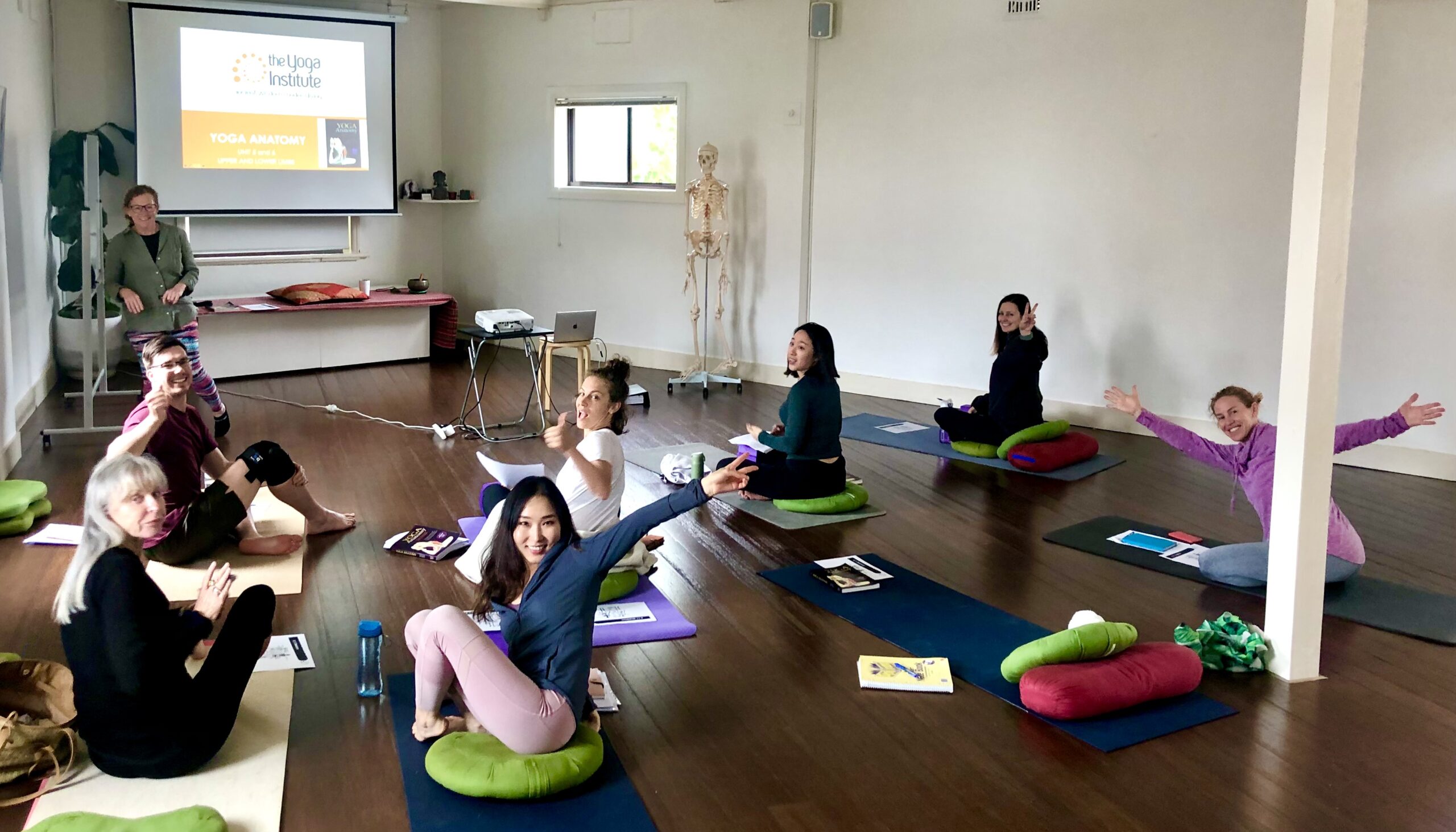

Yes! Some of our shorter courses are available entirely online, from anywhere, including:
6-week Yoga Sutras Studies course (new dates coming soon)
Advanced Pranayama workshop suite (March 2022)

Our longer programmes involve some face-to-face:
100-hour Teacher Training Foundations,
500-hour Yoga Teacher Training, and
650-hour Yoga Therapy Training
We genuinely believe the programmes are better for this inclusion.
In the case of the 100-hour Teacher Training Foundations course and the 500-hour Teacher Training Diploma course, you can concentrate your studio time with us into small, immersive blocks of time (instead of more regular visits to Cammeray), perfect for those based outside of Sydney or those just needing a little more flexibility. As us about our Hybrid/Immersion training intake.
Whatever may come, we plan to remain selective about which classes or topics migrate online, and which may be better suited to re-scheduling so that we can all be together.
We take wellbeing in the studio very seriously. Whenever our premises are open:

The quality of our students’ learning experiences and their wellbeing have always been – and remain – at the heart of all of our operational decisions
For people racing to simply receive the piece of paper, we may not be the best fit. But for those seeking to equip themselves with high-quality education, those wanting to feel a sense of care and community as they enjoy their learning experience, and those who want to prepare themselves to guide true healing transformation in the lives of other people, then The Yoga Institute may be a great fit for you.
Sign up for our newsletters here to easily stay in touch with us!
More questions?
Contact us for a chat on 0477 021 219,or email us at teachertraining@yogainstitute.com.au.
 “Allow a gentle smile on your mouth, you can kind of feel how it shifts the entire physiology. So that’s kind of a concrete, physical way of shifting into this attitude of welcoming and safety.”
Insights at the Edge’s Tami Simon speaks with Shauna Shapiro about the neurology of self-image and why conscious acts of self-compassion greatly enhance our well-being. Shauna comments on practicing mindfulness with warmth and open affection, as well as how this gradually cultivates empathy. Tami and Shauna also talk about “trusting the good heart” and the possibility of changing our baseline levels of happiness. Finally, they discuss why changing ingrained habits is so difficult and the subtle power of the daily self-affirmation, “Good morning. I love you.”
Dr. Shauna Shapiro is a professor, author, and internationally recognized expert in mindfulness and compassion. Nearly one million people have watched her TED talk called “The Power of Mindfulness,” rated one of the top ten talks on mindfulness.
With Sounds True she has written a new book called Good Morning, I Love You: Mindfulness and Self-Compassion Practices to Rewire Your Brain for Calm, Clarity, and Joy, where she brings alive the brain science behind why we feel the way we do about ourselves, each other, and the world, and she explains how we get stuck in thinking that just doesn’t serve us. What I loved about talking with Shauna Shapiro is that here she is, a scientific researcher, PhD clinical psychologist, and she helps us understand the brain science behind how a very simple act, an act any of us can do each morning and say to ourselves, “Good morning, I love you,” might be one of the most powerful acts we can take on a regular basis.
What we practice grows stronger. Good morning, I love you.
Enjoy!
We all get the feeling of being overwhelmed at some point or another. For some, it may be once a year while for others it’s a daily occurance. If there’s ever an article to give you the words of wisdom you need to overcome this overwhelming world we live in, it’s this one.
By: Judith Hanson Lasater via Yoga Journal
Patanjali writes in his most famous Yoga Sutra (1:2): “Yoga is a state in which the agitations of the mind are resolved.” This means that through yoga, we can stop identifying with fear and anxiety, for example, and begin to settle into the now—into an internal silence. Perhaps you have had a glimpse of this state on the mat, walking in the woods, or while worshipping or praying. This deep state of silence Patanjali describes is the residue of our practice but not the asana or meditation practices themselves. We miss the real practice when we are attached to the techniques instead of the residue, or the aftertaste of the practice. When we start to understand that the asana is not the yoga, we realize that the afterglow the asana leaves in our nervous system is the true yoga. This can lead to the radical awareness that refuge can be experienced anywhere, anytime, because it can truly be a choice.
Yoga practices help us get there. By helping to change what we are focused on, asana can become the foundation for us to find the courage and awareness to turn toward our lives with curiosity and presence—to take refuge in the moment. When we try a new, sometimes scary, pose, we are practicing courage, and when we are present to bodily sensations on the mat, we create a new habit of awareness. Restorative Yoga poses are particularly helpful. For example, time spent reposing in a supported Savasana (Corpse Pose) can reinforce that you are “enough” and have value simply because you exist. That’s because Savasana tells your nervous system that it is OK to let go: that you do not have to be doing and producing all of the time in order to feel full and content with who you are. The Savasana practice here helps foster the unimaginably important and radical understanding that you are not your thoughts. As you lie still with your eyes closed and nothing to do, all you have to focus on are your thoughts. You can learn to watch your thoughts rise and fall like clouds in the distant sky. The ability to be even slightly free from the tyranny of one’s thoughts is the beginning of moksha, or the only true freedom.
Pranayama can offer us a way into a state of even deeper contentment. Besides inhalations, exhalations, and breath retention, there is something else that you can contemplate during your breath practice: the utter silence that presents itself between the inhalations and exhalations. Focusing on the moments when you are not inhaling, exhaling, or holding your breath (the natural state of suspension in between the inhalation and exhalation) can have a profound effect on your mind and nervous system. When I practice this focus, it verifies for me that true refuge can only be found within myself and does not come from outside sources. When I’m in this state, I have no worries; I’m totally content with what is.
If you meditate, you know too well how powerful the constant barrage of arising thoughts can be. But meditation can help you create refuge in the midst of your mind. Here are three ways it can work:
Meet The Author: Judith Hanson Lasater

Judith Hanson Lasater, Ph.d. in East-West Psychology and physical therapist has taught yoga around the world since 1971. She is a founder of the Iyengar Yoga Institute in San Francisco, CA, as well as of Yoga Journal magazine.
Ms. Lasater trains yoga teachers in virtually every state of the United States, and is often an invited guest at international yoga conventions. She is president emeritus of the California Yoga Teachers’ Association as well as the author of numerous articles on yoga and health for nationally recognized magazines.
Her most recent book is Restore and Rebalance: Yoga for Deep Relaxation, Shambhala Press, December, 2017. A complete list of Ms. Lasater’s nine books can be found here. She has also created numerous digital courses about teaching and practicing yoga.

There are a myriad of ways to transform your health through Yoga.
Were you aware of the array of benefits that Yoga has been shown to offer people when it comes to ones health and healing? Current research continues to support the validity of such claims (Harvard Medical publication – An Introduction to Yoga). This report reveals with clinical research that Yoga offers so much more than a physical stretch, a way to strengthen and tone your body. It in fact it has a powerful effect on your whole health.
The Health Benefits of Yoga
The list of yoga’s health benefits is quite long and continually growing and more research is done. When it comes to scientific research, yoga is a tricky topic for many reasons, the main one being that there are so many types and styles of yoga. Each style and teachers offers something a little different. Some classes are more asana (physical) focus, while others focus more on pranayama (breathing) or meditation. The bottom line is that yoga has a lot to offer.
Harvard Medical School Special Health Report “An Introduction to Yoga” dedicates a chapter offering an overview of the research on yoga’s physical and mental benefits. Listed in this chapter:
The publication also mentions “Why yoga has so many health benefits”
Yoga is the perfect remedy to assist with everything from heart disease to high pressure to anxiety and depression.
Yoga is a mind-body practice that considers the whole person. A yoga practice may include postures – either static or dynamic movements, breathing techniques, calmative or relaxation practices, practices that enhance vitality, or more contemplative practices such as meditation.
How we approach ones Yoga practice to restore health and provide healing ALWAYS depends on the person. Often when we are limited, or suffering with our health we forget or cannot see the other aspects of our being that we can tap into. Yes – we forget our potential – a well trained and experienced Yoga teacher or therapist can assist people to awaken these other aspects of themselves and see the potential for better functioning, health and healing.
In the Harvard Medical publication on Yoga there was mention of a Clinical Cardiology study where a yoga programme was shown to increase the flexibility of blood vessels by 69% and it even helped shrink blockages in arteries without the use of medications! Now this is promising.
Without a doubt this time-tested ancient practice – Yoga – is here to stay and we look forward to continue to hear more about Yoga’s vast application and usefulness to transform health and support healing.
“Tone and strengthen your body while you lower blood pressure … ease back pain … reduce the risk of heart disease … and improve your memory with YOGA!”
Interested in teacher training? Visit our webpage
Interested in Yoga Therapy Training? Visit our webpage
Interested in developing a personal home practice? Visit our webpage
Have questions’? Email or call: nicole@yogainstitute.com.au 0477 021 219
Here’s your chance to meet The Yoga Institute’s talented, passionate and highly experienced Yoga Teacher Training & Yoga Therapy Training Faculty on a deeper level!
We asked each faculty member the same 5 questions, so you can truly see their unique personality, perspective, and experiences shine.

1) Please write your brief yoga history and involvement with The Yoga Institute?
Brief??? 40+ years worth … many wonderful and sometimes challenging teachers and experiences.
Most significantly, studies and practice in India, under the guidance of my teacher and mentor, Mr TKV Desikachar.
Founded The Yoga Institute in 1999 (originally called Integrative Yoga, then Yoga Sanga), and have remained Director for 20 years.
2) What’s the greatest benefit you have gained from your yoga practice?
Whilst I love the practices of asana, pranayama, meditation, chanting and more, the study and sharing of Patanjali’s Yoga Sutras constantly keeps me both amazed and humbled about what these teachings offer us in understanding our human condition, suffering, and opportunities for personal and collective transformation.
3) Personal shoutout! What lights you up?
Seeing the journey of change and transformation in people’s lives.
4) Where’s your happy place?
At home, in the ocean, in a forest, or in Italy.
5) What are your qualifications?

1) Please write your brief yoga history and involvement with The Yoga Institute?
I came to yoga, or rather yoga came to me, in the late 90’s while I was living just outside New York City. I practiced with increasing frequency throughout the next decade; predominantly by attending classes. In 2009 I learnt the amazing benefits of a daily personal practice when I was introduced to a specific pranayama, breath and mediation series which I committed to for 90 days. After having experienced a whole milieu of health challenges (some of which needed specific medical intervention) I found myself feeling truly well and vital in my mind and body for the first time in over 10 years. Inspired by this, I completed my first YTT in the USA and soon after moving to Sydney in 2011 found my way to the The Yoga Institute where I studied further with Michael de Manincor. In this last decade I have had the great good fortune to study with many teachers both here and in the USA such as Richard Miller, Leslie Kaminoff, Ganesh Mohan, Amy Weintraub, VidyaMa Caroline Dell’Uomo, Devarshi Steven Hartman, Donna Farhi, Heather Plett and many more. Given my background in the corporate world where I coached, trained and consulted in face-to-face communication skills, Michael asked if I would develop workshops in this area for yoga teachers and therapists and as such I have joyfully been part of the TYI faculty since 2012.
2) What’s the greatest benefit you have gained from your yoga practice?
The greatest benefit I have gained from my regular personal practice is an ability to slowdown, pause, come in the moment and be in the witness – after which I can more consciously make choices about what I say or do next. The movement and breath aspects of my practices have also helped my still sometimes “health challenged body and mind” become and stay strong, flexible and vital. I also get a lot of personal joy and nourishment from teaching yoga – both to small groups and individually.
3) Personal shoutout! What lights you up?
Spending time with like-minded and like-hearted people who are curious about this journey called life!
4) Where’s your happy place?
With my family when everyone is getting along 😀!?
5) What are your qualifications? B App Sci – Physical Education

1) Please write your brief yoga history and involvement with The Yoga Institute?
My passion for Yoga started when I was in my teens. I very soon developed a love for this ancient practice and its many styles and tools. After completing my first teacher qualification in a Power Vinyasa Style, I have continued my studies with The Yoga Institute. Under the guidance of Michael de Manicor, I have completed the year long Diploma of Yoga Studies & Teacher Training as well as the Advanced Diploma of Teacher Training. Since then, I have continued my practice and the study of yoga including yoga therapy (3 year course), yogic mindfulness and the Yoga Sutras. Apart from teaching general classes, I focus of teaching seniors with the aim of healthy ageing.
I am committed to teaching and sharing Yoga, making it accessible for each and every individual, whatever their experience.
2) What’s the greatest benefit you have gained from your yoga practice?
My yoga practice has encouraged me to become more mindful in my daily life. A regular yoga practice is so effective in helping you with a wide range of illnesses and stressful situations. It is so much more than ‘just a simple exercise or stretching routine’. Using the breath to connect the mind and the body has such a powerful impact on the mental wellbeing. For me that was one of of the key factors that I have learned when training with Michael.
3) Personal shoutout! What lights you up?
Learning more about the philosophies, world views and teachings that emerged in ancient India. I also enjoy long walks in nature and spending my time with my family and friends.
4) Where’s your happy place?
If we try to define ‘happiness’, the dictionary would probably say that it is a ‘state of being’. I am personally not too sure about that – I would rather refer to it as a temporary emotion. Happiness is centered around what you think will bring you happiness, but as life shows, it might never be enough. Once we acquire or find what we think will make us happy, it tends to loose its meaning very quickly. So very often people spent their lives in this never ending pursuit of happiness. I therefore think that the expression ‘contentment’ is much better. Striving for contentment, a state of balance, allows your mind to focus on living a more meaningful life – not a life in constant pursuit. And that place can be everywhere.
5) What are your qualifications?

1) Please write your brief yoga history and involvement with The Yoga Institute?
I have been practicing yoga for 35 years and teaching for 20 years.
I have been involved with The Yoga Institute since it was Yoga Sanga around 17 years ago. I taught a little on the teacher training course then and a lot on the Friday course when The Yoga Institute began. I taught asana pranayama meditation sometimes energetics and professional yoga teacher. I also had my own studio for 10 years or so in Lindfield then Mona Vale.
2) What’s the greatest benefit you have gained from your yoga practice?
Yoga for me is about the way I live my life. How I interact with everyone and the environment and how I care for my body and mind.
3) Personal shoutout! What lights you up?
Teaching and training mentoring running workshops lights me up. My creativity flows and I love that. I also love to ocean swim and read. I am a curious person and enjoy to keep learning
4) Where’s your happy place?
My happy place is in the water and camping in the bush.
5) What are your qualifications?

1) Please write your brief yoga history and involvement with The Yoga Institute?
In 2010 I enrolled in the Advanced Teacher Training Course with The Yoga Institute. The same year I started teaching general classes and in 2015 I joined the faculty and mentor team. My dream came true in 2016, Michael and I, with our family heritage and love for Italy achieved our dream of running yoga retreats in Italy. Savour Italy has since been an annual retreat.
2) 2) What’s the greatest benefit you have gained from your yoga practice?
The understanding that it’s all in my hands, that the change I desire in my life depends on me. My daily personal practice plants the seed for my transformation.
3) Personal shoutout! What lights you up?
It lights me up to see people passionate for something and making efforts to contribute to their direct environment.
It lights me up finding the time to be in the ocean and see that every single wave is different and I have to adjust to their uniqueness.
It lights me up dancing in the lounge room with my husband and and my son.
A proper made TiramisuIt lights me up… very rare thing in Australia!
4) Where’s your happy place? My family
5) What are your qualifications?
Since 2001 The Yoga Institute has taught and mentored hundreds of students who have gone on to become amazing yoga teachers. We’ve grown a beautiful community of people who have changed their own lives and the lives of others through exceptional yoga teaching. We are humbled to have been part of so much positive change.
You can stay abreast of news from us including trends and developments in the yoga industry, wellbeing news, and important dates about our courses by subscribing to our newsletters here.

Use the breath to stay calm.
Conscious deep breathing works like a brush and helps to clear and focus the mind. It sweeps and cleanses your body and mind, releasing you from tiredness, fogginess, poor attention and stress. Incorporating pranayama in your yoga practice improves awareness and is an essential element to help you create space for energy, clarity, calmness and concentration.
Content from T.K.V. Desikachar’s The Heart of Yoga
Yoga recommends two possible ways for achieving the qualities of sukha, comfort and lightness, and sthira, steady alertness. The first is to locate knots and resistances in the body and release them. The second possible means for realizing the concept of sthirasukha consists of visualising the perfect posture.
The word prāṇāyāma consists of two parts: prāṇa and āyāma. Āyāma means “stretch” or “extend,” and describes the action of prāṇāyāma. Prāṇa refers to “that which is infinitely everywhere.” With reference to us humans prāṇa can be described as something that flows continuously from somewhere inside us, filling us and keeping us alive: it is vitality.
There are five forms of prāṇa, all having different names according to the bodily functions with which they correspond. These forms of prāṇa are:
What happens within this movement of prāṇa and apāna? According to yoga we have a fire, agni, in the body, situated in the vicinity of the navel, between the prāṇa-vāyu and the apāna-vāyu. The flame itself is constantly changing direction: on inhalation the breath moves toward the belly, causing a draft that directs the flame downward, just like a fireplace; during exhalation the draft moves the flame in the opposite direction, bringing with it the just-burned waste matter. It is not enough to burn the rubbish; we must also rid the body of it. A breathing pattern where the exhalation is twice as long as the inhalation is aimed at providing more time during exhalation for freeing the body of its blockages. Everything we do to reduce the rubbish in the body is a step in the direction of releasing our blockages.
The object of prāṇāyāma practice is to emphasize the inhalation, the exhalation, or retention of breath. Emphasis on the inhalation is called prūaka prāṇāyāma. Recaka prāṇāyāma refers to a form of prāṇāyāma in which the exhalation is lengthened while the inhalation remains free. Kumbhaka prāṇāyāma focuses on breath retention. In kumbhaka prāṇāyāma we hold the breath after inhalation, after exhalation, or after both. Whichever technique we choose, the most important part of prāṇāyāma is the exhalation.

When we take up the practice of prāṇāyāma, we should proceed gradually, step by step. Because we are starting something new, directing our attention toward the breath-not the body-it is important to rest for several minutes after we finish āsana practice and before we begin prāṇāyāma. The time between āsana practice and prāṇāyāma practice is not just to rest the body it also helps the mind to make the transition from one practice to the other.
It is possible in prāṇāyāma to fix the ratio between the inhalation, the retention afterward, the exhalation, and the retention after that. The many possibilities for these ratios can be divided roughly into two categories:
There are certain techniques that will help us maintain concentration in prāṇāyāma. In concentrating on the breath, we can focus on the flow of the breath, the sound of the breath, or the place where the most work is occurring. The latter will be determined by the phase of breathing we are in.
Want to find out more? Join our next Teacher Training Information session to find out more: https://www.yogainstitute.com.au/teacher-training-information-sessions/
One of The Yoga Institute’s teachers, Gill Kamsler, made almond & honey oat bars for a recent teacher’s get together. Gill is ALWAYS making delicious food, she has a real reputation around the centre for her cooking!
Make it your own and try adding coconut!

Less then 10 minutes of prep time? Say no more!