Yoga for Surfers

TKV Desikachar, son and student of T Krishnamacharya, friend and teacher of The Yoga Institute’s Founding Director, Michael de Manincor, used to regularly teach that yoga is not only good for general health and well-being, it can help improve many areas of our lives, including our golfing ability. He never mentioned surfing, but the same applies….

Read on to find out……

Strength vs Flexibility

Any repetitive activity that builds strength can come with its challenges of flexibility. Suring is no different.

Too much strength can cause inflexibility and too much flexibility can lead to instability. This is particularly important for surfers as it’s essential to stay quick and agile, as well as have the strength and stamina to paddle either out in rough surf or to gain speed quickly to catch waves.

What to make flexible?

Thoracic & lumbar spine (upper and lower back)– cat/cow pose, focusing on mobilising the top segments of the spine to ensure mobile paddle position. Lower (lumbar) spine also can become tight and overworked, and will need a good stretch and release.

Hip flexors & Hamstrings – low lunge, tucking the tail bone to access lengthening of hip flexor and tilt the buttocks back in the forward bend to release hamstrings.

What to make strong?

It’s important to move dynamically in and out a few times to prepare the body before building strength by holding.

Legs (particularly quads and glutes) – chair pose, pressing into the heels to help engage buttocks

Abdominals & arms – Plank pose and apanasana, controlled movement to build strength

Back – cobra to strengthen and stabilise the back

Breathe for Big Waves

The breath is a very powerful tool to assist with stability, energy and stamina. The more effective we breath, the more effective your ability to surf. The key is to moving and maintaining long, steady rhythmic breathing.

Whether or not you are used to surfing big waves, most surfers would have experienced times when they wish their breath could go on for longer.

The main aim of pranayama is to consciously extend the breath, making it smooth and steady will not only allow you stay under water for longer but also access a sense of calm in your body, even under pressure. The breath effects ever single system in your body.

When working with the breath, it’s important to work gradually for it to be sustainable, but also to avoid creating and negative impact on the nervous system (fight or flight).

  • Anuloma Ujjayi – lengthen the exhale
  • Vinuloma ujjayi – bring the inhale to meet the exhale
  • Breath Retention on exhale
  • Breath retention on inhale

Each step of this process can take months and advised to work with a professional who is skilled at working with advanced pranayama techniques.

Under Water Calm

As divers can testify, the slower you breath, the more focused you become and the longer you can stay under water for, it is no different with surfing. Yoga can help you to maintain and calm and focused mind even in the most stressful of situations, including being dragged under a wave.

Written by Natalie Bowcutt

5 Reasons Warm Weather is Good For Your Health

Bondi Beach in Summer

Are you a snow-lover, or a beach-bum?

There’s lots of reasons you may prefer warmer weather over the cold.

But one thing you may not have thought about is how the weather where you live affects your body.

As it turns out, climate and temperature can have a big impact on your health.

And while you may have your own preferences, the facts are clear: there’s lots of health benefits to living in warm weather.

So pack up your coats, step outside, and let the sunshine in.


5 Benefits of Living in Warm Weather

1. Get More Sunlight

Sunlight exposure increases your body’s vitamin D levels. Vitamin D can prevent cancer, provide higher energy levels, and keep your bones strong and healthy.

And even though Vitamin D is so important for your health, researchers at Central Washington University claim that 77% of people are vitamin D deficient because they don’t get enough sunlight.

If you’re locked up most of the year indoors because of cold temperature, ice and snow, it may be time to consider a move somewhere with more sunshine. Just remember to get a moderate amount, because getting too much sunlight can be harmful as well.

Related Article: Why You Need More Sunlight: The Benefits of Vitamin D

Yoga outdoors
2. Be Physical

Let’s face it – you’re probably more motivated to exercise, or just get up and go, when it’s nice outside. The couch and TV just look a little less appealing when the sun is shining through on a clear day. And research backs this up.

One research study showed that teenagers are more active in the summertime and less active in winter. In a region with warm weather year-round, exercise and physical activity become the norm. 

Related Article: Little Known Exercise Facts That Could Affect Your Memory

3. Improve Your Memory

Research shows that your overall alertness & mental performance is at its best when your body temperature is high. Staying warm in nice weather helps keep you alert and improves your memory.

And sure, you can keep your body temperature up regardless of the temperature outside, but it’s a lot easier when you don’t have to wear 7 layers just to stay warm.

4. Warm Weather is Safer

Studies have shown that death rates are higher in cold climates. People who have easy access to heat & good housing may not be as affected, but for those who are struggling, the winter & cold weather could be a killer.

5. It’s Better for Your Heart & Lungs.

Cold weather can have a negative impact on your health, especially your heart and respiratory system. When your body works to regulate heat, your blood pressure can increase to unhealthy levels, causing long-term damage.

The Takeaway

There’s more to living in a warm area than just getting the benefit of a healthy tan. Warmth and sunlight can offer real benefit to your health. From improved heart and lung health, to enhanced mental performance, living in a warm climate may give you just the health boost you need.

Need some more ideas on what to do this summer? 

Stay in Touch: Subscribe to our newsletter here for more news, events and articles to keep you informed this summer.

Get physical with a yoga class: View our Cammeray Yoga timetable here 

Start thinking about those New Year resolutions: Our first classes for 2022 kick off from February. Start your journey towards deepening your yoga practice or becoming a yoga teacher

Already a teacher and want to learn more? Existing yoga teachers can undertake our Post-graduate Yoga Therapy Training Course

Current medical system: a system of mental illness or health?

Written by Janet Lowndes & Michael de Manincor

Statistics tell us that in each year approximately 1 in 5 Australians experience a mental illness. Not surprisingly, many people who come to Yoga classes experience mental health concerns, such as depression and anxiety.

Mental health is defined by the World Health Organisation (WHO) as “a state of well-being in which every individual realises his or her own potential, can cope with the normal stresses of life, can work productively and fruitfully, and is able to make a contribution to her or his community”. 

The WHO emphasises that “mental health is recognised as more than the absence of mental disorders, and is an integral part of health. Indeed, there is no health without mental health”

(WHO, 2014).

As well as receiving recommendations from family, friends and Yoga enthusiasts, many people come to Yoga on recommendation from their medical and allied health professionals – who now recognise that Yoga can assist in dealing with mental health problems, or ‘mental illness’.

Even though the formal research is still building, peak organisations like Beyond Blue now include Yoga amongst their lists of potentially useful interventions.

Yoga for Whole Health

Whilst there is evidence to suggest benefits of Yoga as a form of treatment for conditions such as Depression and Anxiety, Yoga is not really a system of treating conditions. Rather Yoga is a system that enhances mental health for everyone, those who are experiencing periods of difficulty, and also those wanting to enhance their wellbeing and flourish.

Much of our mental health treatment system in Australia is focused on the treatment of mental illness – rather than on promoting mental health. Yoga offers a comprehensive way of understanding the nature of the human mind, and how this relates to our mental health. So, the focus in Yoga is less on Mental Illness and the associated symptoms, and more on enhancing the health and wellbeing of our entire system.

We can think of our mental health as existing on a continuum, from one end being at our optimum, at the other extreme, a state of disabling mental illness which compromises our ability to function in daily life.

Yoga can amplify symptoms

Yoga practices can have powerful effects, not all of them helpful. In fact, there are some commonly used techniques that can be particularly inflammatory to existing symptoms of anxiety or depression. Techniques such as rapid breathing and breath retentions for people who experience anxiety has be found to intensify or induce symptoms.


Necessity for Teachers to Up-skill

Conditions like Depression and Anxiety are common amongst Yoga students and practitioners, therefore it’s important that Yoga Teachers develop their mental health awareness to enable them to respond appropriately to the needs of their students.

Two of Australia’s leading Yoga Psychologists Dr Michael de Manincor and Janet Lowndes offer professional development, training and education for qualified Yoga Teachers in Mental Health Awareness.

Yoga Therapy Module: Yoga Psychology & Mental Health – next module in 2022

More information and bookings                                                                                        .

Is Restorative Yoga Right for Me?

Written by Jayne Robertson

For many years I had one speed…fast.  And one intensity…hard. So how has a girl like me become so deeply enamored with restorative yoga?   Restorative yoga, as I have been taught, is a deeply healing practice that utilizes props…lots of them (blankets, bolsters, sandbags, belts, chairs, eye covers etc).

It all began when a dear yogini friend of mine named Cheryl said, “I think you’d get a lot out of taking a course in restorative yoga with Judith Hanson Lasater”. I’ve had many endless conversations with Cheryl around everything yoga as we studied yoga therapy together and as a result, a deep and lasting friendship emerged.  I trust her and her opinions as I have relatively few people with whom I can be such a yoga geek.  If restorative yoga is something that Cheryl valued then I thought I would probably find it valuable as well.  So I committed to a four- day intensive with Judith.

During those four days, Judith said one thing in particular that has stayed with me over the years – during the week between Christmas and New Year’s, the only style of yoga she practices is restorative.  When the week is over, she said that everything seems more colorful, easier and the world, in general, more peaceful.  I quietly thought to myself, “Yeah, right…the world turns into rainbows and unicorns with a bit of restorative yoga.”  A couple of days later, as I was driving back from San Diego to the desert and passed through some gently rolling hills, I noticed how lush they were and what a lovely shade of green.  I noticed the blue sky and the white puffy clouds.  And then I caught myself saying out loud, “It’s true!  Everything DOES look more beautiful!”.

Then the magic started to reveal itself the moment I began using a unique way of supporting the head and neck with a blanket during savasana (the final relaxation in every class). People actually moaned with pleasure as I tucked them in…and they still do after these many years of doing so.  What also revealed itself was how deeply healing the practice is and how desperately people need committed downtime to reset the balance of their bodies, minds, and spirits from an over-scheduled and full life.

And then there are the transformational moments that happen.  Just today, I asked a relatively new student to the practice how it was going for her coming to class twice a week.  She said that having been in constant pain for several months, falling out of shape and becoming more distanced from her body was a real concern.  She felt she was pointed in the direction of an electric wheelchair to cope with daily pain and discomfort.  Now, she’s back to walking and doing a stationary bicycle, along with her restorative yoga. But, she said “It’s been the yoga that has pointed me in the right direction.  I’ve completely turned around how I felt, I have hope and am managing my pain like I haven’t for a long time.  It’s enabled me to become more active with the walking and cycling. It’s amazing.”

I tried not to act too surprised in hearing her experience, but I couldn’t help but feel my heart expand.  Some of us need restorative yoga because we’ve always had the default speed of hard and fast.  Others need it because they have crazy busy lives and must step out of it for a while and finally, others step into the practice because they’ve been in physical or emotional pain that at times seemed beyond a turning point.

I’ve always said if you can breathe, you can do yoga.  But if you want to alter your nervous system and create better balance in your lifestyle, then perhaps restorative yoga is for you.

Still not convinced?  Come give it a try and let your body, mind, and soul do the talking.  You might just hear yourself say, “ahh”

Date: Saturday 12th – Sunday 13th August 2017

Location: The Yoga Institute, level 1/498 Miller Street, Cammeray, NSW

Times:
Saturday: 10:30am-5:30pm
Sunday: 9:30am-6:15pm

A Story of Personal Transformation: Marcus Slight

Marcus Slight is a man who has experienced a lot of pain and trauma. Here, his moving story acts as an inspirational tale of the strength he found through his Yoga journey.

How Yoga found him

In December 1999, a life-changing moment involving an accident at work reset Marcus’ course forever. Marcus worked in construction and after a faulty safety guard forced a piece of metal into his skull, he describes being hit with an energy that exploded through his body, leaving him hospitalised for 11 days with a shattered face, broken ribs, torn arteries and a split deep into his skull.

In that moment, Marcus experienced an overwhelming connection to a higher power. He heard a voice from within ask “do you want to live?” and a laughing response, “I’m trying”.

It left him with post-traumatic depression, stress, chronic pain and he found it difficult to communicate due to a severe lack of confidence.

He was 20 years old.


Healing

After 6 months of pain medication, Marcus built up an immunity, so turned to marijuana for relief. He saw countless doctors, psychologists and other healthcare practitioners but the addiction to drugs continued. After the death of a close friend, he heard once again that ‘higher power’: “If you don’t stop, you’ll be next”. He listened.

Marcus found himself in South East Asia for the following 10 years, allowing him to integrate back into the community, connecting with people. He learnt to live off the land which formed part of the healing process, having been introduced to the Yogic concepts of respect and gratitude.


Life takes another turn for the worse

A financial crisis led to his return to Australia with $100 to his name.

He began selling drugs. A thread of events, including chaotic relationship breakups, family troubles and the final straw of 12 police holding guns to his head was “enough to shock the system”. This resulted in his realisation of being an addict due to chronic pain, 11 more months of unsuccessful withdrawals and admittance to a Detox Clinic.

With little support from family and friends, Marcus went through weeks of detox. It induced immense pain and violent outbursts. It was a tough time to endure, both physically and emotionally. The drug fog had cleared so he had to confront past trauma, failed relationships and lost loved ones.


The Journey to change

A 12 month residential, therapeutic-based community rehab program introduced him to Yoga. He found the contrast of addiction being dishonest and quiet, when recovery was honest and willing, very confronting. The hard work was all ahead.

The centre’s weekly Yoga Teacher, Jane encouraged him to move and stabilise his imbalance from losing an eye. He convinced the centre to add daily Yoga to the schedule. One Sunday the class didn’t happen as they were a teacher down and Marcus and other patients noticed a significant difference in their behaviours – more irritated and distracted. The benefits of the daily practice were evident.

Marcus had his first exposure to teaching then; he started leading yoga classes in the morning and with Jane’s encouragement and extra classes he focused on the goal of becoming a teacher. From there everything changed.


Key learnings

“The physical is nice but the effect on my mind has been profound”

His year of study at The Yoga Institute gave him time to absorb and integrate into this daily life.

Through his study, he realised the importance of an individual approach.

“Nobody has my story and I don’t have anyone else’s. My students have stories, physical and mental conditions. I feel I now have the skills and knowledge to cater for their individual needs”

Studying the Yoga Sutras directly helped him recover through reflection into the nature of his own mind. He recalls the moment he realised addiction was detailed in the sutras (kleshas) as being a profound moment. A true example of ancient wisdom integrated into modern living.

The connection Marcus describes with his ’higher power’ became clearer. His relationships with others improved. Learning to listen and use words consciously enabled him to speak confidently for the first time in years.


Life Now

Marcus now lives a life without medication. Pranayama is his new pain treatment.

He uses chanting at work to calm his internal environment.

He uses his breath as a tool to evaluate before responding. His favourite quote being:

”Few things are so pressing they can not wait for a moment of breath” TKV Desikachar


Clean from drugs, Marcus got his first job during the year of his studies and has learnt how to be loving a compassionate towards himself. He now lives in gratitude of the realisation he is continuing to share.

He says of Krishnamacharya’s contribution to the World “I feel so grateful to be ‘part of the chain’”.

Marcus has been off drugs for 2.5 years.


“Chronic pain no longer defines me, it is no longer my excuse. Pranayama is now my chronic pain management”


Thank you Marcus for sharing your inspiring story with us.

It Depends: Yoga for Hips

by Sarah Loveband

When considering a suitable yoga practice for tight hips, it depends….    

There are various factors which could be responsible for a person’s sensation of tightness in the hips. Muscle shortening, scar tissue, conditions like osteo or rheumatoid arthritis or even a person’s anatomical boney structure can limit their range of movement (ROM). As a yoga teacher or yoga therapist – a facilitator of functional movement amongst other things – it’s useful to educate yourself on the causes of tightness (perceived or actual) so you can assist people in initiating and maintaining movement in the best possible way for their body.

For many people, the most common cause of hip tightness is lack of movement. Due to work demands, many people are required to sit for up to 8 hours a day (and sometimes more) with their hips in a flexed position. Prolonged hip flexion places the muscles at the front of the hip (known as the hip flexors) in a shortened state whilst on the opposite side of the pelvis, the gluteals (which are responsible for hip extension), are lengthened.  As a result, the muscles anterior to the hip (at the front) become short and tight whilst the gluteals (at the back) are stretched and weakened.

Aside from a slight sensation of tightness at the front of the hip, one of the most common symptoms of tight hip flexors is lower back pain. This is because one the primary hip flexors (the psoas) attaches to the anterior side of the lower lumbar spine and to the anterior femur. Thus tightness in this muscle pulls on the lower back creating pain. Because the pain is felt in the lower back many people seek to perform stretches over the lower back area. However the source of the pain is on the opposite side of the body.

There are many factors that can result in low back pain, so as always IT DEPENDS on individual circumstances, whether the sequence described below will be appropriate.

A simple practice to address hip flexor tightness

To alleviate tightness in the hip flexors it is recommended that people who ARE experiencing this, perform the asanas mentioned below multiple times per week. Always begin with gentle dynamic movement – moving in and out of the posture with the breath 3-5 times – then introduce long holds of at least 30+ seconds to allow the muscle fibres to release.

Knee to Nose – Start in an all fours position, on an inhale, extend one leg straight behind you, on your next exhale, bring the knee towards your nose. Repeat the movement 3-5 in time with your natural breath, extending leg on the inhale, moving knee towards nose on the exhale. Repeat on the other side. This movement encourages the hip flexors to contract and relax which is recommended prior to moving into a stretch position.

Kneeling Lunge – Start in a neutral upright kneeling position, on an in-breath, move one leg forward into a lunge, on the next out breath move the leg back to the kneeling position. After 3-5 dynamic repetitions moving back and forth between the upright kneeling to lunge position with the breath, hold the lunge for 30+ seconds with weight shifted forward, mentally scan over hip flexors and direct your breath to this area. Repeat on the other side.

Bridge & Psoas stretch with block – Start lying on your back with your knees bent and feet flat on the floor, hands by your sides on the floor, palms up. On an in-breath lift the hips, moving into a ‘bridge’ pose, on your next out-breath return the hips to the floor. Repeat 3-5 times in time with your natural breath, moving hips up on the in-breath and back down on the out-breath. On your next inhale after you raise your hips, place a block under the sacrum (back of pelvis, at base of spine) and extend one leg. Resting the heel of the extended leg on the floor, bring the opposite knee in towards the hip with hands resting on knee. Hold for 30+ seconds, mentally scan over hip flexors on the extended leg side and direct breath to this area. Repeat on the other side.

#Tip: Some students may find placing a block underneath the sacrum uncomfortable, in which case you can cover the block with a blanket for more cushioning.

#Tip: If you suffer from tight hip flexors you should also aim to strengthen the opposing muscle group, the gluteals, as this will create physical balance within your body.

To strengthen gluteals:

  • Bridge: Performed dynamically with the breath as described above. After you raise your hips not eh in-breath, pause, hold & squeeze gluteals at the top, using the contraction of the glutes to move the hips further into extension. #TIP – you can even touch your glutes for a moment so you can feel the muscles contracting, thus building mind/body connection, exhale release and roll down with control. Doing 10 repetitions of this up and down movement in each set, complete 3 sets, resting between sets. Repeat multiple times per week.


Bodywork Therapies: It doesn’t have to be painful

How many of us subscribe to the philosophy of ‘no pain – no gain’ and apply it to various aspects of our lives?

Yet when we truly practice yoga, we learn to develop a relationship with our body, where we listen to what it is telling us and respond and move in a way that is deeply honouring.  After all, yoga means union and how can we be in union if there is not a true respect for the body. To me this means no pushing, no hardness, no pain.  With this, there is much to actually gain.

Pain is the body’s feedback mechanism to say stop what you are doing. Our mind can often override this signal, but at what cost to the body? When pain is felt, the body responds by causing the muscles to harden up around the injured site for protection to avoid further injury.

So what happens when we actively go into a movement that stretches the body to an extent where there is pain?  The connective tissue (or commonly known as fascia) also hardens up in order to protect the body.

This fascia is a system of tissues that runs throughout all the muscles, tendons, ligaments, bones, nerves, blood vessels and organs, overlapping and enveloping these soft tissue structures like cling film. The purpose of this system is to protect these important parts of our bodies.

So if one of our aims in practising the physical postures of yoga is to loosen and open the body, to have more fluidity, then why would we induce pain and cause more tension? It just doesn’t make sense.

We can apply our understanding of this principle in our practice of yoga, and it also makes sense to apply it to bodywork therapies including massage.

As a yoga teacher, connective tissue therapist and massage therapist, I have come to understand that the best way of releasing tension in the body is through the quality of connection – not force.  A stronger stretch in yoga or a harder stroke in massage may offer temporary relief, but does it solve the underlying problem in the long term? In my experience the answer is no.

For long term healing, the approach that I take as a bodywork therapist is to respect and respond to the connective tissue by working with the body in a connected and gentle way.

As an example, in massage, rather than forcefully working into a trigger point (a point of tension held in the muscle) to access the deep tissue and muscles, the body requires lots of repetitive strokes to first of all warm up the outer layer of muscles allowing access to the next and deeper level of muscles (hence the name deep tissue). If you try to access the deeper muscles via force and without truly understanding the role of the connective tissue in the body, the outer muscles harden and go into protection, working against what we are trying to achieve, which is to relax the muscles. Once the outer muscles have been warmed up, then we can access the deeper tissue in a gentle manner, with no force and without inflicting pain.

With the modality of Esoteric Connective Tissue Therapy we work with gentle hands-on healing techniques performed with slow rhythmic motion on various parts of the body. The therapy works directly with both the physical structures of the body (muscles, joints, etc.) and the energy that flows through the connective tissue system and in turn releases tension and tightness in the muscles.

By listening to the body and treating it with absolute care and gentleness it leads the body towards it own natural state of healing with no pain inflicted.

Written by Donna Gianniotis 

The Importance of Holding Space

What is ‘Holding Space’?     

Most of us do this every day whether we realise it or not. With our family members, friends, students, colleagues and sometimes even strangers. It is both a simple and a complex undertaking. Simple, in that Holding Space for another essentially involves allowing them to say what they need to say, or be how they need to be.  It’s complex, because for many of us, that’s quite hard to do.

I became more aware of this term – Holding Space – in November last year when I had the good fortune to study with internationally recognised and highly regarded writer, speaker, facilitator and coach, Heather Plett when she came to Australia to lead some programs in Writing and Living with an Open Heart. She had created a definition for Holding Space in a blog piece published in 2015 (that went viral to three million people within a week of being posted!), which brilliantly encapsulated what the concept involves.

“It means that we are willing to walk alongside another person in whatever journey they’re on without judging them, making them feel inadequate, trying to fix them, or trying to impact the outcome. When we hold space for other people, we open our hearts, offer unconditional support, and let go of judgment and control.” Heather Plett

How to Hold Space

In my experience one of the biggest factors that allows me to Hold Space effectively for another, is being fully present.  And, as you might guess, what has allowed me to be more capable of being fully present in my regular, personal yoga practice that incorporates many wonderful yoga tools; especially chanting, pranayama and meditation. Intentionally and consciously choosing to Hold Space is also easier when I can be in my Witness Consciousness (Vijnanamaya kosha) practicing non-judgment and compassion for the other person. Connecting with my breath, slowing down, narrowing my focus of attention and connecting with my heart-centre also supports this endeavour.

Since I have become more aware of the concept and action of Holding Space I have realised how often I actually do it.  And I bet you will too. When I am teaching (both in classes and 1-1), when mentoring, offering yoga therapy or even when I pick my daughter up from school and we talk about her day, I am called upon to Hold Space. Being conscious of what I am doing has allowed me to develop my capability of how I do it.

As Heather eloquently closes her blog…

“Holding Space is not something we can master overnight, or that can be adequately addressed in a list of tips I’ve just given. It’s a complex practice that evolves as we practice it, and is unique to each person and each situation.”

So, just like yoga, I invite you to think of Holding Space as a practice. A life-long practice.  And if you do, it will allow you to serve and support others in both an open hearted and healing way.

Lucy Karnani

Lucy is a senior teacher at Cammeray Yoga and is part of the faculty of The Yoga Institute. She has created and runs training in the communication and interpersonal skills for teaching yoga for classes and one-on-one, informed by her 25 years of experience training and consulting in face-to-face communication in the corporate world. She lived and worked in New York, USA for 17 years before returning to Sydney in 2011.
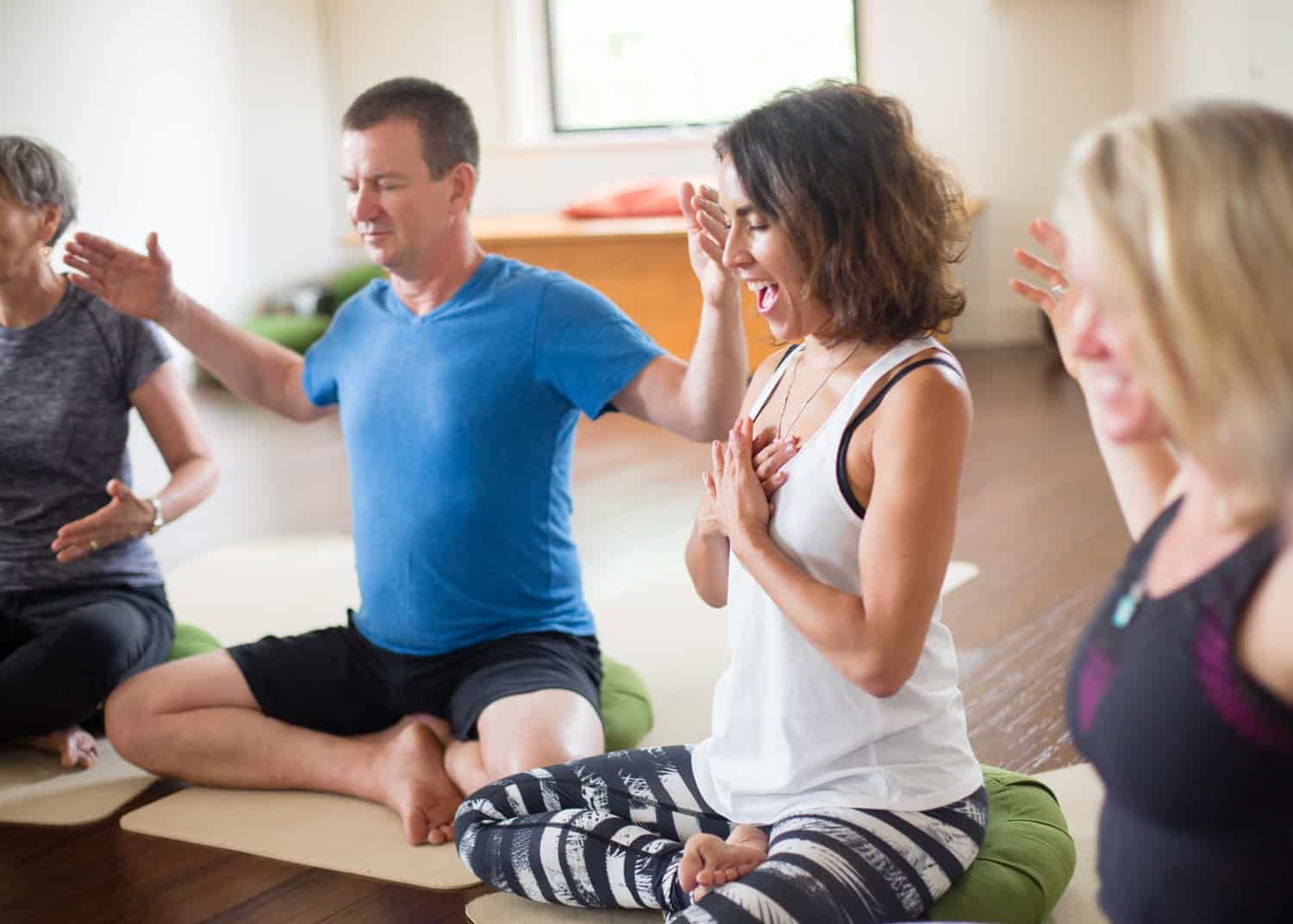
Lucy passionately believes in yoga as a system for healing and transformation of the body, mind and spirit. She has personally felt, as well as seen many times, the powerful healing that can be experienced from the simple act of sincerely being ‘listened to’; she brings this and much other wisdom to her facilitation of the “Love and Listening Circle” and “The Heart of Yoga Program”.

Does Yoga improve your mental health?

Michael de Manincor’s PhD research says yes!

The Facts

In today’s society mental health concerns are becoming more and more prolific.

In 2011-12, it was estimated that three million people in Australia (13.6% of the adult population) had a mental health condition, an increase from 11.2% in 2007-08, and 9.6% in 2001 (Australian Health Report, ABS, 2012). And, there are many more people who experience some form of anxiety that is not diagnosed or reported.

We may experience a mental health concern ourselves, or know a loved one who is.


What’s the treatment for mental health?

In Australia and other developed countries, medical & psychological treatments are the most common form of treatment for most mental health conditions. Medical treatments include a range of pharmaceutical medications, and the most commonly used form of psychological treatments is Cognitive Behaviour Therapy (CBT).

Whilst there is extensive medical research on the effectiveness of these treatments, there are questions about their overall effectiveness, side effects, cost effectiveness, individual choice, and access to services, compliance, and ethics.

Yoga is becoming more recognised as an intervention for mental health concerns, particularly for depression and anxiety disorders, and there is growing scientific evidence to show this.

In my own PhD research, we conducted a clinical trial to evaluate the effectiveness of individualised yoga for reducing depression and anxiety and improving overall mental health and well-being. We gave a personalised yoga practice to over 100 people who were experiencing depression or anxiety. The results were outstanding!

We found that overall measures of depression went down by 36%, anxiety went down by 26%, psychological distress went down by 33%, resilience increased by 10%, and overall mental health improved by 19%.


There is no one-size-fits-all

These are significant results which demonstrate mental health benefits of a personalised yoga practice.

There is no “one-size-fits-all”. Each person was given a personalised yoga practice that was suitable for their individual needs and abilities. We also need to be aware there are some things in yoga that may not be helpful for everyone, especially in the area of mental health. For example, some of techniques used to help people with depression, such as kapalabhati (rapid breathing) might actually increase feelings of anxiety. And techniques to help reduce anxiety, such as long exhale or slower breath-centred movements, my not be helpful for depression.

The point is – you can’t just go into a general yoga class, and hope for the best. Practices need to be more tailored to individual needs.

Having a teacher who knows how to design personalised yoga practices, may be able to assist us in developing a yoga practice that is suitable for our individual needs, and can have significant and sustainable benefits in managing mental health and improving well-being.


Written by Michael de Manincor BA (Hons), Grad Dip Ed, M Psych, PhD

If you would like a copy of the published results of Michael’s clinical trial research, please email us reception@yogainstitute.com.au


Join us to learn more:

Yoga Teacher Training Information Session
Date:
 Saturday 10th November 2018
Location: The Yoga Institute Sydney
Facilitators: Michael de Manincor
More info and book your place

Tips for Teaching Kids

What is the most effective Yoga practice for kids? Well……IT DEPENDS….

Why do kids need Yoga?

There are, what seems like, an infinite amount of benefits of practising yoga for children. There is however, still no one-size fits all for children, as each learn and are motivated in different ways.

  • More and more children and young adults are experiencing anxiety
  • Social pressure increasingly complex, inflamed further by social media
  • Less physical activity in day to day lives due to increased screen time

Engaging in well-designed, regular classes can help to strengthen and align growing bodies, development self-regulation and relaxation skills, focus and calm young minds, increase attention and memory as well as plant important seeds for later in life.

It depends…

Before embarking on teaching children yoga, important considerations need to be made and class plans designed and delivered accordingly. Key considerations are:

  • Age

Differences in age groups can make a huge impact. A guideline would be seperate ages groups into ‘toddlers & preschool’, ‘young children’ 5-8, ‘older children’ 9-12, ‘teenagers’ 13-16 and ‘youth’ 15-19.

*mostly asana focus with dynamic and varied sequences

*headstands only from teens onwards and counter poses are not so important generally until teenagers

*alignment generally only understood in older kids


  • Physical fitness and/or development

Not all kids are flexible and strong so individual considerations should still be taken for muscular skeletal developments, general strength and natural flexibility. Also, consider appropriateness of practice for overweight children, growth spurts and speed of recovery / breath changes


  • Interest / willingness / readiness

There will be a mixture of kids who have chosen to come and some who have been sent by parents or schools. Some will be confident and others not, so consider ways each child can have a sense of achievement and manage expectations. There will also be some who might have special needs so consideration for any additional training or support in Yoga Therapy you may need.


  • Psychological development & history

Based on many factors, each child will have different ways of coping and responding to situations so it’s important to guide them into accepting feelings and situations e.g. ‘it’s ok to feel like this”.

Use games to practice exploration, self-awareness as well as concentration and memory. e.g Postures and Sanskrit words

Top tips

  • Small vs Big classes – small enough to give personal attention to each student


  • Set ground rules – you could get them to write them down at the start of each class. Create rules of mutual respect for teacher, each student and awareness of group dynamic. Encourage non-competitive community (yoga sanga). Ensure mats are cleaned and put away and relaxation time is valued


  • Stimulate curiosity – create games and maintain engagement with lots of questions ‘Can you say namaste?’ ‘How did you feel in warrior pose?’ ‘Which poses do you remember? E.g. Yoga Box to include animal poses or Jumping pillow – when they are stood on it they say “I feel….”


  • Be intense – louder, happier, crazier, more positive than they are!


  • Manage your expectations – children are children so don’t expect them to behave like adults. Walking away, chatting and playing is part of who they are so have realistic expectations and always take the class with a light spirit and have fun


These are for general advice only, we always recommend seeking a qualified teacher to help fine tune and guide you through a personalised practice, just for you.


The Yoga Institute acknowledges the Cammeraygal people of the Eora nation as the Traditional Custodians of the land on which our centre is based.

Copyright The Yoga Institute 2025

Built by IRONIC3D in Sydney